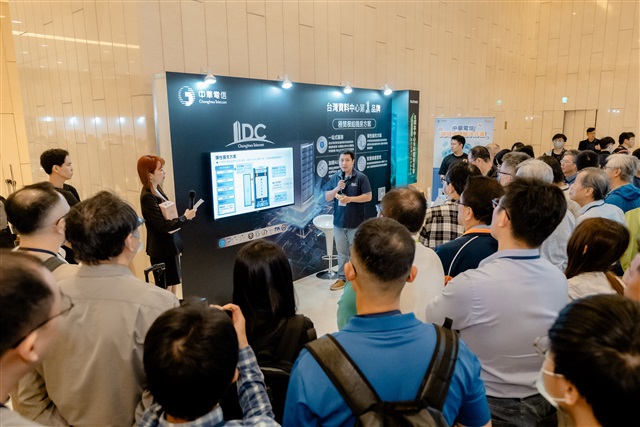
As AI applications gradually expand from the cloud to enterprise private clouds, smart factories, logistics centers, and edge nodes, enterprise compute density continues to rise, pushing the power capacity, floor loading, and cooling systems of traditional data centers to their limits. AI server specifications are evolving rapidly, while traditional data centers typically require 12 to 24 months to complete the full process from planning and design to construction, testing, and delivery. The growing gap between the pace of infrastructure deployment and the evolution of AI technology is becoming a bottleneck for enterprises looking to adopt AI applications. Even after equipment procurement is complete, enterprises may still be unable to deploy as scheduled if the required data center infrastructure is not yet ready.
To help enterprises bridge the timing gap between infrastructure deployment and rapid technology iteration, Chunghwa Telecom has introduced its "Simplified Modular Data Center Solution." Built around the core concept of "Data Center in a Rack," the solution integrates cooling, environmental monitoring, access control, and fire protection into modular racks. The standard IP55-rated racks are pre-assembled and tested at the factory. Once the equipment arrives on site, deployment is completed based on the available power supply, cooling source, and piping conditions. This reduces on-site engineering work and coordination across multiple vendors, enabling enterprises to bring their compute environments online faster.
Prefabricated Modules Cut Build Time While Preserving Flexibility for Expansion and Relocation
Chunghwa Telecom IDC Marketing Manager Shih Chun-wei noted that traditional data centers are typically planned as a one-time buildout based on projected demand over the next five to 10 years. The construction process requires coordination among multiple vendors and specialists covering building works, mechanical and electrical systems, low-voltage systems, air conditioning, and fire protection. From design and planning through delivery and commissioning, the entire process typically takes about 12 to 24 months. Large-scale, upfront investment in a data center can also result in significant idle capacity. To accommodate future expansion, enterprise data centers are often provisioned with substantial power and cooling capacity from the outset. Initial equipment utilization, however, may be below 20%, meaning that depreciation and warranty periods may already be running before some of the infrastructure is fully utilized.
Simplified modular data centers are built using factory prefabrication and modular on-site assembly, with systems such as cooling, fire protection, and environmental monitoring pre-integrated and tested before delivery. Once delivered to the site, the modules can be quickly installed and brought online without the need for raised flooring. This can shorten data center construction to four to six months while reducing on-site fit-out, piping and cabling work, and testing. It also helps reduce construction noise, dust, and waste disposal requirements. Provided that the site, power supply, cooling source, and other required infrastructure conditions are in place, the deployment period can potentially be reduced from the 12 to 24 months required for a traditional data center to about four to six months.
The actual schedule, however, will still depend on site conditions, project scale, and applicable review and approval requirements. The modular design also enables enterprises to shift from large, one-time data center investments to phased deployment based on their compute requirements. As server counts and business needs grow, enterprises can gradually expand rack capacity as well as power and cooling resources. This allows infrastructure deployment to better align with server procurement and AI application rollout schedules, reducing both idle capacity in the early stages and upfront investment pressure.
Four Cooling Configurations Help Enterprises Meet the Demands of the AI Era
To accommodate different types of IT equipment and compute densities, Chunghwa Telecom currently offers its Simplified Modular Data Center Solution in four cooling capacity configurations: 3kW, 5kW, 20kW, and 53kW. The 3kW and 5kW configurations use side-mounted or rear-mounted cooling units and are suitable for general network equipment and servers. The 20kW configuration uses a refrigerant-based cooling system with an outdoor unit located within 20 meters and can support entry-level to mid-range AI servers. The 53kW configuration uses chilled-water cooling and can connect to an existing chilled-water system or a separately installed chiller, primarily supporting high-end AI servers.
In terms of power supply and floor load capacity, the 3kW and 5kW configurations can accommodate an uninterruptible power supply (UPS) and batteries within the rack, with a recommended floor load capacity of more than 300 kg per square meter. For configurations of 20kW and above, the UPS and batteries are installed separately, with a recommended floor load capacity of more than 500 kg per square meter. Chunghwa Telecom IDC Marketing Manager Shih Chun-wei noted that before implementation, the Chunghwa Telecom team conducts a comprehensive assessment and develops an appropriate solution based on server specifications, peak power consumption, on-site chilled-water availability, piping and power configurations, and the enterprise's requirements for system redundancy and service availability.
Smart Monitoring and Alerts Boost Day-to-Day Operations and Maintenance Efficiency
The Simplified Modular Data Center Solution features a modular design, allowing enterprises to add optional modules such as smart monitoring and automatic fire suppression based on their needs. Smart monitoring provides continuous visibility into rack conditions, including temperature and humidity, smoke detection, door status, cooling system operation, and power consumption data from the power distribution unit (PDU). When the system detects an abnormality, it can notify operations and maintenance personnel through preset alert channels such as email, Microsoft Teams, or SMS, reducing the time required to detect and address issues. Even if the external network connection is interrupted, the local host can temporarily store up to approximately 5,000 environmental monitoring records and synchronize them once connectivity is restored. The actual number of records may vary depending on the data content and system settings. By integrating monitoring data and alert information, enterprises can remotely monitor and manage equipment conditions, cooling systems, and power usage. In addition, enterprises can add optional smoke detection and in-rack automatic fire suppression modules based on site-specific fire safety conditions and regulatory requirements, with deployment planned in coordination with the existing fire protection system.
One-Stop Planning, Deployment, and Operations and Maintenance Services Enable Rapid Infrastructure Upgrades
When building an AI compute environment, enterprises must address power supply and distribution, cooling, fire protection, monitoring, networking, and construction works. If these areas are handled by different vendors, enterprises must devote substantial resources to coordinating stakeholders, consolidating requirements, and managing the overall project. Drawing on more than 20 years of data center operations experience, Chunghwa Telecom brings comprehensive engineering integration capabilities to provide enterprises with one-stop data center solutions spanning initial consultation and planning through deployment and delivery.
Chunghwa Telecom's professional team collectively holds more than 300 certifications related to data center construction, operations, and maintenance, including CDCP, CMVP, refrigeration and air conditioning, electrical and electronic engineering, and fire safety certifications. At the initial stage of deployment, the team develops a preliminary plan based on factors such as the customer's server specifications, equipment power consumption, cooling requirements, and redundancy needs. A multidisciplinary team of experts then conducts an on-site assessment of power, cooling, piping, and other site conditions to develop an optimal solution tailored to the enterprise's site and business requirements. During the construction stage, a single point of contact coordinates the construction, power, cooling, and networking teams while overseeing project progress and system integration, reducing the complexity of cross-vendor coordination for enterprises. Once the data center has been completed and delivered, enterprises can manage it remotely through the smart monitoring and alert system. If OEM technical support or warranty service is required, Chunghwa Telecom can also serve as the customer service contact, providing a consistent service experience spanning planning and construction through operations and maintenance.
As AI projects move from proof of concept to full-scale operation, the challenges enterprises face extend beyond model training and server procurement to power, cooling, cybersecurity, and operations and maintenance capabilities. If the supporting infrastructure is not ready in time, even the most advanced computing equipment may be unable to enter service as planned. Through prefabrication, modular design, and one-stop integrated services, Chunghwa Telecom's Simplified Modular Data Center Solution helps enterprises transform traditional, large-scale, one-time data center projects into compute infrastructure that supports rapid deployment, phased investment, and continuous expansion. Enterprises can start by building for current demand, reducing the burden of managing large-scale projects and minimizing idle capacity in the early stages, while retaining the flexibility to upgrade equipment and expand compute capacity over time. This enables infrastructure deployment to keep pace with the development of AI applications.