
With a series of industrial development policies implemented by the China government, the past five years (2006-10) have seen China's animation sector grow at a rate making it among the nation's fastest growing industry segments. Looking forward, there remains a lot of room for growth. Based on the CNY39.7 trillion GNP achieved by the country in 2010, the output value for the cultural industries account for only 2% of the total, and the animation sector was less than a tenth of that sector's total output value.
China's animation industry includes production of animated TV series and films, as well as animation produced for use on the Internet (including cell phone animation), and the combined production value topped CNY20.8 billion in 2010. The industry scale is projected to exceed CNY50 billion by 2015, buoyed by government-led protective policies including incentives to push for more dedicated cartoon channels and restricted imports of foreign animation.
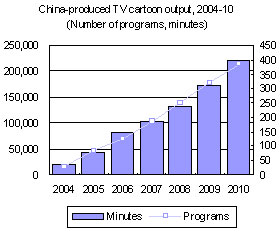
Animated TV series were the largest contributors to China's total animation production in 2010 with 220,530 minutes worth of output. If the output momentum remains strong, China is expected to surpass Japan in TV animation production in the foreseeable future.
With R&D and production capability improving, China's animation industry is seeing some initial success and has expanded its market reach beyond television to movie animation and animations for Internet-connected devices such as mobile phones. The sector's promising future has also attracted investment from venture capital firms. Having being involved in the government-led economic and social development program, China's animation sector is expected to boom over the next five years.
Chart 2: Production value of major cultural industry segments, 2010 and 2015 forecast (CNYb)
Table 1: Industry evolution and government policy development in 2004
Table 2: Computer animation industry evolution: Phase 2 goal
Chart 3: Introduction of China animation satellite TV channels
Chart 4: Animation programs in major cities, minutes of airtime, 2004
Chart 6: China International Cartoon & Animation Fesival trade value, 2005-11 (CNYb)
Chart 7: China-produced TV cartoon output, 2004-10 (Number of programs, minutes)
Chart 8: China TV cartoon production by province, 2008-10 (Minutes)
Table 4: China TV cartoon production rank, by company, 2008-10
Table 5: China TV cartoon production rank by national industry cluster, 2008-10
Chart 9: China TV cartoon production rank by genre, 2008-10 (Proportion of programs)
Chart 11: Production capacity share from national animation industry bases, 2007-2010
Table 6: Overview of major national animation industry bases in China
Hangzhou Hi-Tech Industry Development Area (Industrial Animation Park)
Chart 13: Movie poster of The Dreams of Jinsha, by Shi Long Animation
Shengyang Hi-Tech Industrial Development Zone Animation Industrial Park
Chart 15: Policies for animation industry from local governments in China
Table 7: Animation industry policy from Hangzhou municipal government
Table 8: Animation industry policy from Xiamen municipal government
Table 9: Animation industry policy from Beijing municipal government
Table 10: Animation industry policy from Wuxi municipal government
Table 11: Animation industry policy from Shenyang municipal government
Chart 16: China Top-5 original animation firms, 2008-2010 (minutes)
Chart 20: Hunan Blue Cat Cartoon Media: Blue Cat Dragoons (3D)
Chart 21: China animated movies box office sales, 2004-2010 (CNYb)
Table 12: Box office sales of top ten animated movies in China 2010
Table 13: Domesticly produced animated movies released in 2011 (incomplete list)
Chart 23: Top six platforms from China Mobile for different types of mobile phone
Table 14: Revenue share of related firms in China's mobile phone animation industry
Chart 24: Analysis of China's mobile phone TV business model
