Artificial intelligence is just an interesting theoretical problem for many scientists and engineers, but it is at its most useful when it directly responds to the needs of its users.
That's why Amity Solutions, a component company of Thailand-based Amity Group, developed Eko Agentic, a data analyst for store managers. They were long-standing consultants to one of the biggest retail chains active in Thailand and Malaysia with thousands of stores in the region. Executives at this retailer told Amity Solutions that they had tried to use various AI tools to improve the efficiency of their store management, but that these tools were not adequate for their needs.
Store managers, stock replenishers, and other frontline workers on the store floor have to handle numerous disconnected tasks on a daily basis. They might use dashboards to monitor various store performance metrics, but synthesising the disparate information into business decisions can be complicated, with store managers resorting to past experience and guesses. Inexperienced store managers, in particular, might be unable to respond effectively to new situations or to best implement requests from headquarters.
What if AI could take over the data analysis from store managers? Amity Solutions developed Eko Agentic to do just this: It is trained with data on how the top-performing store managers across the retailer's large network would respond to various business situations, and then rolled out across other stores, taking into account each store’s particular characteristics. The goal is to reduce extra, unsellable stock; to avoid empty shelves; and to better time and set up promotions.
This way, the retailer tries to make all stores as efficient as those run by the best store managers.
In its first iteration of Eko Agentic, Amity Solutions identified those stores that consistently outperformed the average, both through looking at store performance metrics and by talking to headquarters. Positive outliers were also identified in different environments – for example, the best inner-city markets (which tend to be smaller) and the best rural hypermarkets (which tend to be larger) – in order to get the widest possible range of data.
Amity Solutions then sent teams to perform interviews at each of these stores, asking frontline workers to explain how they would think through various situations. What would they do if sales dropped by 5 per cent year-on-year? Perhaps the store manager would first check the basket size, then check the average value of each item in the basket, and then check for the use of special promotions.
AI – and in particular, a technique developed by Amity Solutions called reflective optimisation via automated debugging (ROAD) – then structured these interviews into decision trees that visualised the store managers' train of thought. Most optimisation methods so far rely on large data sets for testing and calibration, but these interviews with store managers at Lotus's produced a smaller data set, something that ROAD's algorithm could work with.
This was especially important in the Thai context because most large language models are trained on Western datasets, but differences in culture and the business environment between the West and Thailand (e.g., in the availability of parking lots) meant that other models, trained on larger data sets, weren't necessarily immediately applicable.
The model was then applied to each individual store, generating a strategy that had been optimised for each one. Reinforcement learning (a paradigm within machine learning that seeks to optimise the impact of an agent's actions based on continual feedback to that agent from those impacts) is then used to further optimise store managers' strategies.
Despite this rather simplistic description (and its correspondingly smaller size), Eko Agentic has been remarkably effective in data analytics. It is cheaper than many other AI tools (such as Claude and ChatGPT), and outperforms other state-of-the-art LLM and AI data analysis agents in an industry-standard set of real-world problems, the Data Agent Benchmark for Multi-step Reasoning (DABStep). It achieved 41 per cent accuracy in resolving DABStep tasks – the highest amongst all such agents – whilst its nearest competitor, Microsoft, only achieved 32 per cent accuracy; Anthropic's, OpenAI's, and Google's systems lagged even further back.
Eko Agentic is also now able to outperform human analysts working at the Thai retailer. A blind test was conducted, wherein both Eko Agentic and a human analyst performed an analysis on various real business problems. Store managers then select the better of the two responses, without knowing who composed each one. The first versions of Eko Agentic still performed below a human analyst, but the latest version – the fifth – gives, on average, suggestions that are favoured over those from a human analyst.
There are only a few supermarket chains in Thailand, and Amity Solutions is, of course, unable to work with the competitors to the retailer it currently works with. However, their methodology is applicable to other retail applications – and in fact, Amity Solutions is currently using Eko Agentic to help a telecommunications giant in Thailand manage its mobile phone shops. Amity Solutions is also looking for opportunities to apply Eko Agentic to supermarket chains in other Southeast Asian countries.
A potential limitation with basing decisions on what the best store managers would do is that one might be limited to – and thus not be able to improve on – how well the best store managers do. In other words, you can interpolate performance but it is uncertain whether you can extrapolate to even superior strategies.
Thus, as one of its next steps, Amity Solutions is creating a large behavioural model (LBM) that serves as a stand-in for customers. It is a digital twin that simulates customer behaviour, and models that respond to this LBM can potentially outperform the current best store managers.
Amity Group, with offices in Thailand, Malaysia, Singapore, Australia, India, the United Kingdom, and the United States, employs 800 staff members over five companies in various realms of AI. Amity Solutions, the business unit that commissioned Eko Agentic through its long-standing collaboration with the aforementioned retailer, is based in Bangkok and employs 150 employees.
However, it was Amity's AI Research and Application Center (ARAC), whose small team of just 15 staff members deploys generative AI solutions across all of Amity's daughter companies, that developed the technology behind Eko Agentic. Currently based in Thailand, they aim to stay at the forefront of developments in AI, says Touchapon Kraisingkorn, the chairman of ARAC and the executive director of Amity – and thus they have plans to expand ARAC to Singapore.
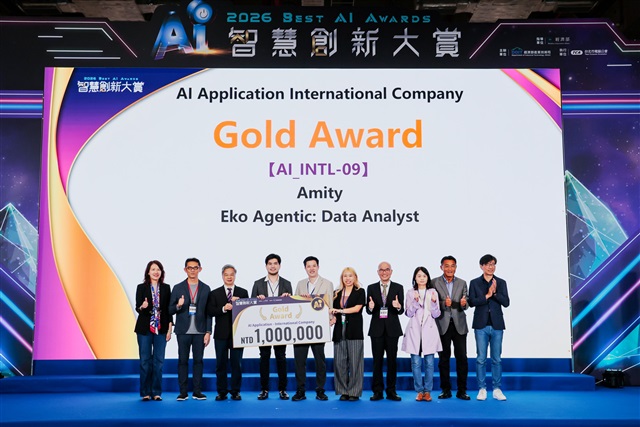
Winning at the Best AI Awards is, says Kraisingkorn, validation that they are "one of the world-class labs that creates an effective product and solves real-world problems". The earnings from this award will help them jump-start hiring in Singapore. They are also open to opportunities for collaboration with Taiwanese companies in chips and robotics.
The Best AI Awards celebrate global excellence in artificial intelligence and IC design, welcoming submissions from innovative companies and brilliant student teams. Following the success of the 2026 edition—advised by the MOEA, organized by DoIT, and executed by TCA—the prestigious competition is officially transitioning into an annual tradition.
Offering substantial grand prizes and unmatched industry exposure, the countdown to Best AI Awards 2027 has already begun. Details on the next submission cycle, prize tiers, and eligibility rules will be released soon. Connect with us on LinkedIn for the latest official updates and application alerts.