As AI technology matures, robotic applications are flourishing across industries, with many seeking new business opportunities. However, challenges vary when it comes to actual implementation. Kevin Chiang, COO of Dunqian, Taiwan's largest hotel operator, recently stated that current hotel robots should focus on repetitive, high-frequency tasks requiring minimal communication. He noted that the hospitality industry highly values emotional interaction, and only as AI and sensing technologies advance will robots be able to handle more complex scenarios.
Chiang stressed that service remains at the core of hospitality, with technology serving as an aid rather than a replacement. The ultimate goal of introducing robots is to free human staff from repetitive work, transforming operations from purely human-driven to collaborative human-robot efforts.
Smart hotel operations across three regions
Dunqian operates 14 hotel brands, including the well-known "CHECK inn" chain, with over 4,500 rooms spanning Taiwan, Japan, and Southeast Asia. Positioning itself as a smart hotel group, Dunqian developed the Hexa one-stop platform adopted by around 700 other hospitality businesses.
Chiang pointed out two major headwinds facing Taiwan's hotel sector in recent years: low domestic travel occupancy compounded by extreme weather reducing travel willingness, and increased outbound tourism driven by yen depreciation, both intensified operational pressures.
Targeting high-frequency, low-communication tasks
Analyzing pain points, Chiang explained that traditional hotels rely heavily on SOPs involving numerous manual service steps, including delivering amenities and room assistance. These processes incur high costs and limited efficiency, especially since hotels operate 24/7 but often cannot fully staff night shifts due to labor shortages.
Given this context, leveraging intelligent robots and automation to deliver guest services will be critical for future smart hotel operations. Currently, robot deployment should target "high-frequency, repetitive, low-communication" tasks such as delivery, transport, restocking, and guidance.
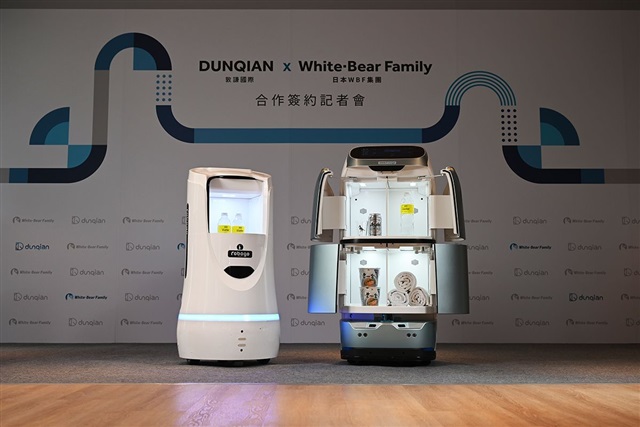
Dunqian began integrating service robots at CHECK inn hotels in 2017 to deliver amenities. They also combined delivery robots with smart vending machines to boost efficiency—guests order via website or app, robots retrieve items from vending machines, then autonomously take elevators to deliver to rooms. Operational data shows up to 200 deliveries per day on weekends and about 50 on weekdays, with a high success rate.
However, Chiang acknowledged two prior failed attempts: deploying a robotic bartender and a mechanical arm luggage storage system. These failures were not due to cost or equipment limitations but reflected the complexity of identifying which hotel scenarios suit automation versus those better served by humans.
Three key challenges in robot adoption
Regarding challenges in adopting robots, Chiang identified three main areas: technology, management, and customer experience. Technically, diverse communication protocols and operating systems among hardware vendors lack standardization, complicating cross-system integration. Managing elevator scheduling, floor access control, and varying floor heights remains a significant engineering hurdle.
Looking ahead, Chiang envisions building open hotel robot collaboration APIs and communication standards to enable multi-brand robots to coordinate across different hotel environments. This would allow hoteliers to refocus on core service values, emphasizing human-robot collaboration rather than full automation as the ideal model.
Article edited by Jerry Chen