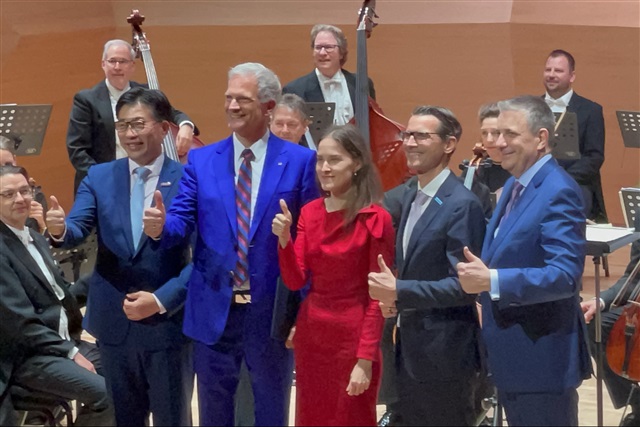
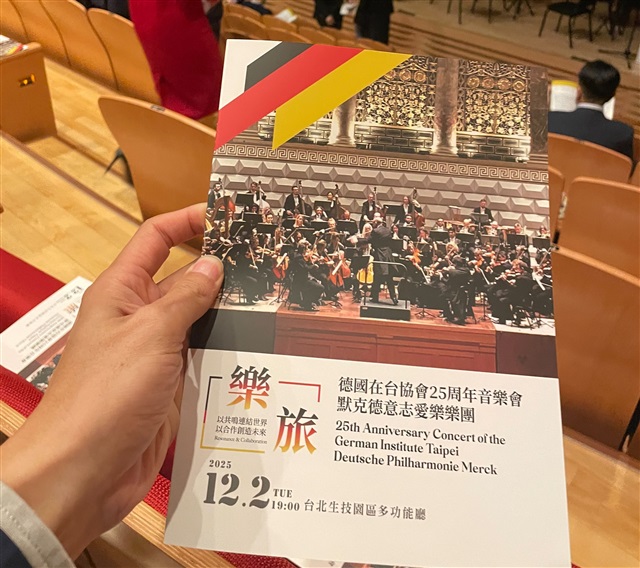
Germany and Taiwan marked a symbolic convergence of politics, culture, and industrial strategy on the evening of December 2, 2025, as the Deutsche Philharmonie Merck performed at a concert celebrating the 25th anniversary of the German Institute Taipei.
The celebration followed Monday's inauguration of Merck's new semiconductor flagship campus in Kaohsiung, a five-year, EUR500 million investment that expands Taiwan's local capacity in thin-film precursors, specialty gases, and formulated materials for AI and silicon-photonics applications.
For Merck, the campus is its first large-scale semiconductor materials technology site worldwide, and a bet on both Taiwan's resilience and the rising global demand for advanced materials.
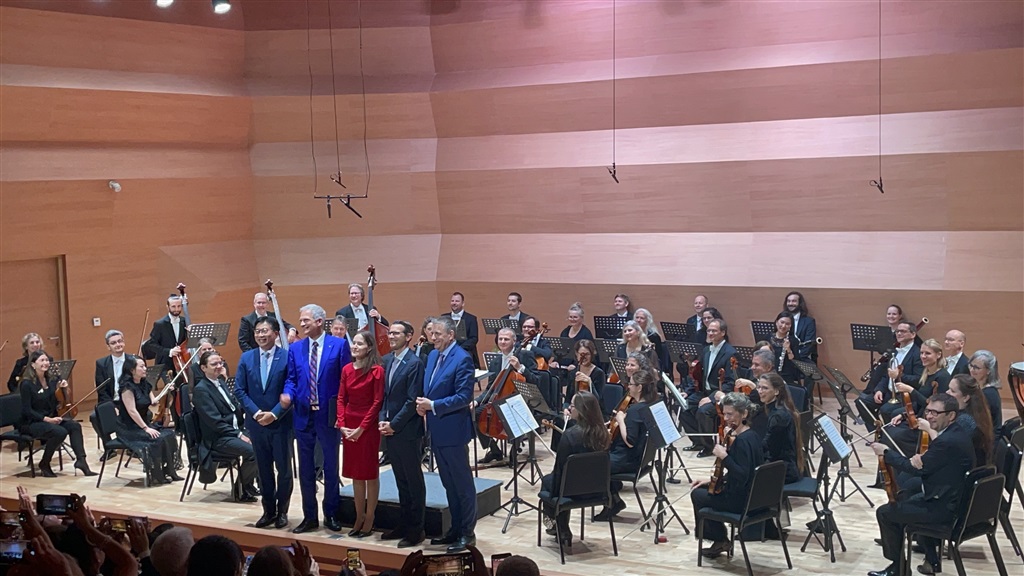
Karsten Tietz (second from left), Dr. Eva Langerbeck (in red), and Dr. Simon Thelen (second from right). Credit: Joseph Chen
Tietz: 'We are team freedom'—and the next 325 years begin now
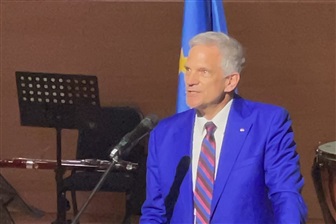
Opening the evening, Karsten Tietz, Director General of the German Institute Taipei, cast the anniversary in sweeping terms. He likened the Institute's founding in 2000 to the start of a marriage, calling the 25th anniversary a "silver wedding anniversary"—traditionally "the biggest party after the wedding" in Germany. Taiwan and Germany, he said, were marking the milestone "with great confidence, knowing that the best years are yet to come."
Tietz traced the Institute's evolution from its early days to its present home in Taipei 101, highlighting a 25-year record that includes visa-free entry for Taiwanese travelers, a double-taxation agreement, cooperation in renewable energy, emissions trading, AI, microelectronics, and even rural development—the latest agreement signed only last week.
When he arrived last summer, he said, he came with "one clear mission—to deepen and widen the cooperation between Taiwan and Germany in all areas," a goal now backed by the largest personnel expansion in the Institute's history, with six new positions added in three years.
Credit: Joseph Chen
But it was Merck's longevity that inspired his boldest claim. Learning that the company has survived and adapted for more than 350 years, Tietz said he wanted the German Institute one day to look back on a similar legacy. "We have 325 years to go," he told the audience, urging, "Come on, Taiwan. We can do this."
After thanking Merck for bringing its orchestra to Taipei, Tietz added a humorous aside: while classical music may be one of Germany's "unique selling points," it is not standard corporate policy. "If you think we require all our DAX-listed companies to maintain their own orchestra, I have to disappoint you. This is truly one of Merck's unique selling points."
Shared security challenges unite democracies
The speech turned sharply political as Tietz outlined the pressures facing both Taiwan and Germany: an increasingly aggressive neighbor, gray-zone attacks, the need to strengthen self-defense, and reducing dependence on fossil-fuel imports that create strategic vulnerabilities.
He quoted Germany's chancellor Friedrich Merz —"we have to be able to defend ourselves so that we never actually have to defend ourselves"—and linked Europe's and Asia's security directly.
Germany's support for Ukraine, he argued, flows from the same logic: "If we turn our back on our friends in Ukraine today, who will ever believe we will not turn our back on any friend in need?" The war, he said, is not a regional conflict but part of "one big global struggle": authoritarian rule versus democratic rule, human dignity versus oppression, free trade versus coercive dependence.
"We are in this struggle together—Germany, Taiwan, Ukraine, and the rest of the free world," he said. "We are Team Freedom." And, like a marriage strengthened over time, he added, "the best years are yet ahead."
Diplomacy requires harmony—just like a symphony
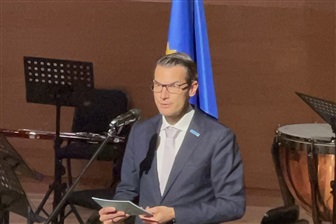
Prof. Dr. Simon Thelen, Vice Chairman of the Family Board and Board of Partners of E. Merck KG, followed with a light correction to Tietz's 325-year target: the Institute actually has 332 years to go. He called the anniversary "a remarkable milestone" that reflects the "strength of collaboration and shared values between two cultures."
The evening's theme, "resonance and collaboration," he said, captured the essence of the relationship. Music resonates across borders, and collaboration among institutions makes that resonance endure. Merck, he noted, has benefited from this kind of partnership for more than 35 years, advancing innovation in Taiwan alongside its customers and partners.
As the orchestra prepared to perform Schubert, Mozart, and Beethoven, Thelen said their universal language offered an apt metaphor: "Just as diplomacy and partnership require harmony, so too does a symphony. Each instrument, like each institution and each individual represented here tonight, plays a vital role in creating something greater than the sum of its parts."
Credit: Joseph Chen
Langerbeck: Merck's largest Taiwan investment signals long-term confidence
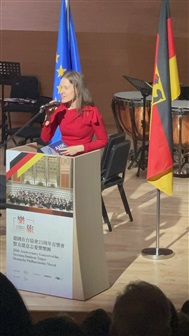
Dr. Eva Langerbeck, Chief Representative and Executive Director of the German Trade Office Taipei, offered brief but pointed remarks on Monday's Kaohsiung announcement.
She noted that Merck's newest facility represents the company's largest investment in Taiwan—over NT$17 billion—and includes the first global semiconductor materials technology center of its kind. She described the project as demonstrating "very impressive confidence" in Taiwan as a production base and in the long-term strength of the semiconductor industry.
While the other speakers offered brief greetings in Chinese, Langerbeck was the only one to deliver full paragraphs in Mandarin—a gesture that stood out and drew warm applause.
Credit: Joseph Chen
A partnership expressed in industry, politics, and music
The juxtaposition of Monday's semiconductor campus launch and Tuesday's anniversary concert underscored the layers of the German–Taiwan relationship: geopolitical alignment, expanding industrial cooperation, and cultural exchange.
With Merck's 357-year corporate history as inspiration—and Tietz's 332-year countdown as a challenge—officials from both sides signaled that their partnership is not only deepening, but envisioned on a century-scale horizon.
Credit: Joseph Chen
Article edited by Jerry Chen