
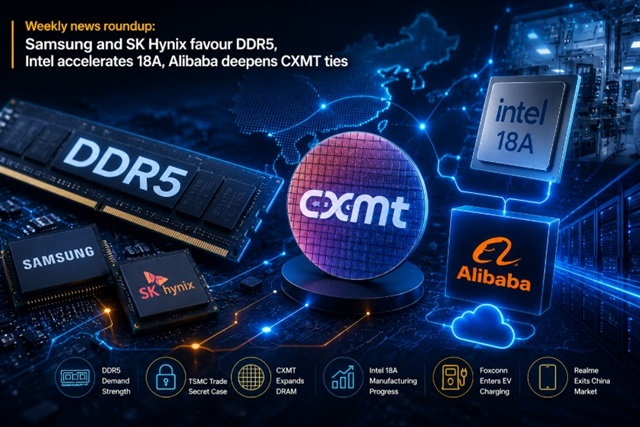
AI infrastructure, memory and advanced chipmaking led this week's tech agenda, with Intel, Samsung, SK Hynix, CXMT, Alibaba and Foxconn reshaping capacity and supply chains. Below are the most-read DIGITIMES stories from the week of July 20-26, 2026.
Samsung, SK Hynix prioritize DDR5 as margins near HBM levels
Samsung Electronics and SK Hynix are shifting flexible DRAM capacity towards server DDR5 while maintaining committed HBM output, as some 64GB DDR5 RDIMMs now generate more revenue per wafer and conventional DRAM margins reportedly exceeded HBM by over 15% in 1Q26. Meritz Securities estimates suppliers met only 75-80% of demand in 2H26, potentially falling to the 60% range in 2027. Samsung also awarded DRAM tester contracts worth KRW49.85 billion (approx. US$33.5 million) to Exicon and KRW8.6 billion to Neosem.
Taiwan indicts ex-TSMC employees in first China-linked national core tech espionage case
Taiwan prosecutors indicted four former TSMC employees for allegedly stealing advanced process technology for transfer to China, the island's first National Security Act case involving "national core technologies." Prosecutors said a former senior engineer surnamed Hsu recruited others to photograph and transfer confidential files via cloud storage and external devices.
Separately, former TSMC executive Wei-Jen Lo remains under investigation over possible trade-secret violations after joining Intel, prompting ITRI to revoke his academician title unanimously.
Alibaba builds three-layer AI empire across chips, memory and models
Alibaba has invested about CNY7.6 billion (approx. US$1.12 billion) for nearly 5% of CXMT through Alibaba Cloud and Alibaba Network, making it the DRAM maker's largest industry investor ahead of its STAR Market IPO. The stake could be worth more than CNY130 billion, or roughly 17 times the investment.
CXMT strengthens Alibaba's three-layer AI strategy spanning hardware and cloud infrastructure, model ecosystems and applications, alongside investments in Montage, ASR Micro, VastaiTech, Lightelligence, Z.ai, Moonshot AI, MiniMax, LimX Dynamics, RobotEra and Unitree, plus at least CNY380 billion planned for AI and cloud infrastructure over three years.
Foxconn's Vietnam arm moves into EV charging equipment
Foxconn Industrial Internet's Vietnam unit Fulian has added EV charging equipment to its business scope after raising charter capital 4.3% to VND9.86 trillion (approx. US$376 million). Ingrasys injected US$287.1 million in March, lifting Foxconn's total investment in Fulian to about US$668 million. The Bac Ninh-based subsidiary employs roughly 130,000 workers, while Foxconn operates 20 projects in the province worth about US$4 billion.
The move complements Foxconn's AI server growth, including 22% higher 4Q25 revenue of NT$2.6 trillion and planned capex growth of over 30% in 2026, though no EV charging output or investment targets were disclosed.
Haesung DS lands CXMT as DDR5 substrate customer, weighs panel production for DDR6
Haesung DS reportedly began supplying DDR5 package substrates to CXMT in 2Q26 after passing qualification in 1Q26, with larger shipments expected in 2027. CXMT plans to double DRAM capacity to about 600,000 wafers monthly, while Haesung DS is considering KRW150–200 billion in panel-production equipment for higher-layer DDR6 substrates targeted for 2028–2029. The company posted 1Q revenue of KRW188.7 billion, up 37.2%, and operating profit of KRW11 billion.
Realme exits China smartphone market, Oppo hands domestic focus to OnePlus
Realme has ended smartphone production and new launches in China, with Oppo assuming after-sales service, warranties and software support. Inventory may sell out by November. The restructuring assigns China to OnePlus and overseas markets to Realme after rising component costs and product overlap. Realme's India share fell to 9% in 1Q26 from 11%, while FY2025 revenue dropped 8% to INR176.59 billion.
Intel reassigns global fabs, eyes early 14A and EMIB-T AI wins
Intel is reorganising its global manufacturing network around 18A, 14A and advanced packaging after investments from the US government, SoftBank and Nvidia. Supply-chain sources estimate 18A capacity at 30,000 wafers monthly with yields above 80%, Arizona Fab 52 ramping in late 2026, and 14A production in 2029, six months early. EMIB-T yields have reached 98% and reportedly won AWS and Google orders, while Malaysia's Pelican packaging project begins in 2027.
Article edited by Jack Wu