
India is accelerating its semiconductor and electronics ambitions, courting Taiwan, easing China restrictions, expanding local manufacturing and chip infrastructure, while global technology companies deepen investment despite rising costs and regulatory risks.
India frames its chip build-out as redundancy for the world, and Taiwan as its partner in building it
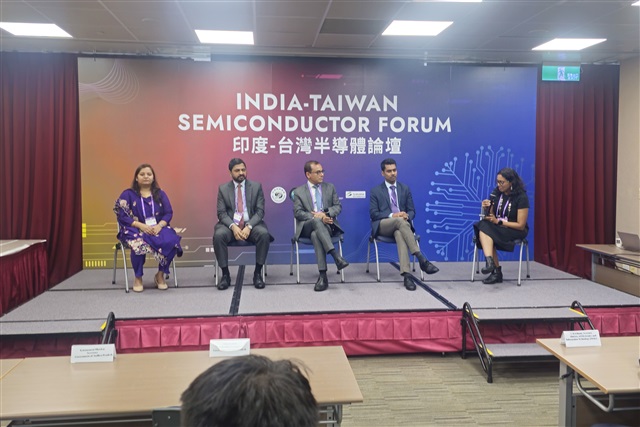
India's most senior semiconductor policymakers came to Taipei with an argument aimed squarely at the Taiwanese supply chain: the country's chip program is meant to add redundancy to an over-concentrated global industry, not to substitute imports behind a wall. For Taiwanese materials, gas, equipment and packaging firms, that reframes India from a distant end market into a second production base their own customers are already asking them to staff.
India says it cannot build electronics without China and has started easing the rules to prove it
India is selling its semiconductor build-out abroad as a hedge against an over-concentrated supply chain. The officials running it are unusually candid that the hedge cannot be built without the country it hedges against. Asked at a media briefing in Taipei on 4 September how New Delhi views the role of Chinese companies in India's chip and electronics supply chain, S. Krishnan, secretary of India's Ministry of Electronics and Information Technology, opened with a line that would be politically awkward in most capitals: "We need to be realistic."
India's IndieSemiC targets 3 to 5 million Wi-Fi camera modules as local CCTV rules spur demand
Indian chip design company IndieSemiC is targeting shipments of 3 to 5 million locally made Wi-Fi modules in FY27-28, betting that security requirements for CCTV equipment will encourage camera makers to replace imported connectivity modules with products sourced in India.
Syrma SGS Elemaster opens electronics plant in southern India to serve global markets
A new electronics factory in Bengaluru is set to strengthen India's role in global supply chains, with potential benefits for customers in railways, industrial systems, energy, and medical devices worldwide. The facility highlights rising demand for high-reliability manufacturing and deeper India–Italy industrial ties.
India's HCLTech opens semiconductor lab in Bengaluru to serve global chip supply chains
HCLTech has opened a new semiconductor laboratory in Bengaluru, a move that could matter for chipmakers and device makers worldwide as they look for faster testing, qualification, and failure analysis. The facility is designed to shorten development cycles, support production quality, and strengthen India's role in the global semiconductor ecosystem.
Samsung India reportedly cuts jobs as memory costs squeeze electronics unit
Samsung Electronics' Indian unit has reportedly started cutting jobs in its TV and home-appliance businesses as higher memory-chip prices, currency weakness, and soft consumer demand squeeze margins across its local electronics operations.
India's TCS unit secures land in Hyderabad for planned 1GW AI data center campus
HyperVault, a Tata Consultancy Services (TCS) subsidiary, has secured 264 acres in Hyderabad to build a large AI data center campus capable of reaching 1GW of capacity. The project could strengthen India's role in global artificial intelligence infrastructure, while influencing jobs, energy demand, and digital supply chains worldwide.
Acer India tablet deal points to deeper push in Asia-Pacific
Acer has landed a nearly US$200 million tablet order from the state of Uttar Pradesh in India, underscoring the company's growing public-sector business in one of its fastest-expanding markets. Acer Pan-Asia Pacific operations president Andrew Hou said India revenue exceeded US$700 million in 2025 and could top US$800 million in 2026 as the company moves closer to a US$1 billion revenue target.
Xiaomi warns of more India price hikes as AI squeezes the phone from both sides
The same AI boom that is filling handsets with new features is draining the memory supply that makes cheap phones possible—and in India, the world's second-largest smartphone market, buyers are paying for both. Xiaomi India's leadership told HT Tech that prices will keep climbing through the second half of 2026 as the global chip shortage persists, even as the company doubles down on AI features it says should be felt rather than seen.
India's fraud office seeks a Xiaomi probe as the market it once led shrinks around it
A recommended corporate-fraud investigation would reach Xiaomi at the weakest point its India business has known. India's Serious Fraud Investigation Office (SFIO) has proposed a detailed probe into alleged irregularities in the company's business model and its compliance with foreign investment law, according to a government memorandum drafted in May and reported by Reuters on September 9.
Article edited by Jerry Chen