
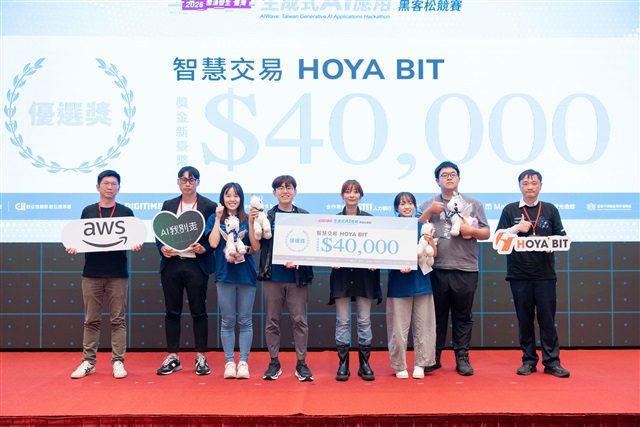
The cryptocurrency market operates 24/7, with prices fluctuating rapidly and critical data scattered across news platforms, social media, order books, and research reports. Relying on a single AI agent for market research can easily lead to analytical bias, unverified assumptions, or AI hallucinations. To solve this, team "Strawberry Soufflé Believers" developed a multi-agent consensus system in which seven distinct AI models cross-examine and challenge each other's analysis before issuing a final output. Competing in the "HOYA BIT: Smart Trading" category, the team won top honors at the 2026 Taiwan Generative AI Applications Hackathon, organized by DIGITIMES under the guidance of the Administration for Digital Industries (ADI), Ministry of Digital Affairs (MODA). Amazon Web Services (AWS) served as the AI technology provider, delivering the generative AI and cloud services that powered the solutions.
Seven AI Agents Debate to Reach a Traceable Consensus
The team highlighted that even an advanced AI model with strong reasoning capabilities can fall into a single line of thought and overlook opposing evidence. This problem is particularly acute in crypto, where news, macroeconomic events, or capital flows can be interpreted as either bullish or bearish. If a single model takes a stance too early, its subsequent analysis will often suffer from confirmation bias. By forcing AI agents to engage in structured debate, the system drastically mitigates single-model reasoning errors.
During operation, a primary analytical agent generates an initial report on a specific token or market issue, after which secondary agents - utilizing models such as Claude - independently audit the output from multiple perspectives. Even if a news item is categorized as bullish, rival agents are programmed to search for hidden risks and demand additional evidence from the primary model. If disagreements arise, the discussion continues iteratively until a majority consensus is reached.
This architecture leverages Loop Engineering and Graph Engineering concepts, routing model outputs through predefined nodes and relationships. Every agent functions not only as a content generator but also as an auditor and devil's advocate. Rather than simply giving a buy or sell signal, the final report compiles the underlying evidence, disputed points, and shared conclusions, providing investors with full analytical transparency.
Accelerating Multi-Agent Development with AWS
To build this complex system within the hackathon's tight schedule, the team customized existing AI development frameworks, completing core features in a single day—a process that would normally take weeks using conventional methods. The platform relies on Amazon Bedrock, a fully managed service offering access to hundreds of foundation models from leading AI companies, for multi-model orchestration, serverless AWS Lambda for backend workflows, Amazon S3 for data storage, and AWS Amplify for deployment. After discussions with event staff, the team focused their project squarely on enhancing the trustworthiness of AI-generated financial research.
Looking ahead, the team notes that multi-agent consensus alone does not guarantee absolute accuracy if models share the same flawed input data. To prepare the system for institutional deployment, the team plans to integrate historical data backtesting across different timeframes and market cycles to validate model performance. Additionally, they are developing advanced data-source credibility rankings and cross-validation pipelines to filter out unverified market rumors before the agents begin their debate.