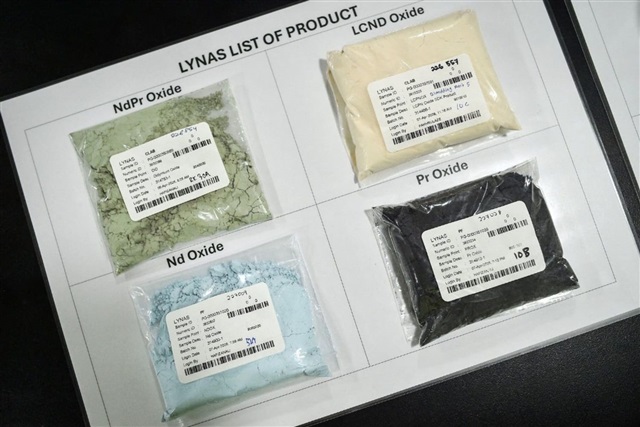
Malaysia has approved its first export of unprocessed rare earths under a new regulatory framework, with the shipment intended for research and development, although officials did not identify the recipient.
South Korean memory module substrate maker TLB has begun developing substrates for SOCAMM3, a next-generation low-power memory module for AI servers, with two major memory customers at home and abroad, according to sources. The company expects SOCAMM3 to enter mass production in 2028 as it expands SOCAMM2 production and builds capacity to retain its position in the high-end memory module substrate market.
Executives from Chinese nickel producers plan to meet as early as October 20 to seek coordinated production cuts at Indonesian processing plants as weaker prices and rising costs pressure margins. The talks could affect global nickel and battery supply chains, but their timing and outcome remain uncertain amid ongoing policy challenges in Indonesia.
Vietnam has installed 10 Starlink satellite internet terminals on islands near Haiphong, highlighting how low Earth orbit networks are being used to extend connectivity beyond conventional infrastructure. The deployment provides backup communications for emergencies and could support digital development, while also illustrating the service's regulatory limits, cost challenges, and focus on remote users.
Global Tek Industrial held an opening ceremony on the 20th for its Super Smart Manufacturing Park in Chonburi, Thailand. Spanning 177,600 square meters, the facility is the group's largest single production base. Having entered trial production in the third quarter of 2026, the plant will expand beyond existing automotive orders to incorporate high-value-added products such as AI liquid cooling and aerospace components, fulfilling customer demand for non-China supply chains.
More than a dozen US companies are exploring opportunities to develop Malaysia's rare earth industry, seeking alternatives to China-dominated supply chains as Washington pushes to secure supplies of critical minerals.
Malaysia wants data center investors to bear the cost of transmission upgrades required by their projects, tying investment decisions more closely to local grid readiness. New applications are already assessed against local grid capacity planning, according to the Ministry of Energy Transition and Water Transformation, while Wood Mackenzie identifies transmission and distribution readiness as an increasingly important constraint on growth in Johor.
Transmission systems integrator TiMotion Technology plans to begin trading on Taiwan's Emerging Stock Board on October 21 as it marks its 20th anniversary, with the company targeting record revenue in 2026 on strong industrial demand and expansion into the robot market.
Anthropic has opened its fifth Asia-Pacific office in Singapore and signed a memorandum of understanding with the city-state's digital ministry, broadening cooperation on AI safety, security, evaluation, and adoption. The move expands the company's presence in a market where Claude use is among the highest in the world, with implications for governance.
Malaysia's push to move from assembling chips to owning the designs behind them has reached the point where it must find buyers. On October 16, the government unveiled six semiconductor innovations developed by local companies, putting their combined sales potential at MYR300 million (approximately US$73.5 million), while Economy Minister Akmal Nasrullah Mohd Nasir said winning customers and passing industry qualification were still ahead.
Singapore is targeting high-value semiconductor manufacturing, advanced packaging, and silicon photonics, building on its strengths in engineering, precision manufacturing, and reliability, according to Zeng Yi Wong, assistant managing director for manufacturing at Enterprise Singapore (EnterpriseSG).
Singapore is moving its AI strategy beyond pilot-heavy experimentation toward a more deployment-focused model centered on enterprise adoption, sector transformation and resilient access to compute.
FICG is aggressively expanding optical communications production in Malaysia and China to meet surging AI-driven demand, which the company estimates is 3-4x current supply capacity. Chairman Leo Chien described the next three years as a "frenzied expansion period," with the company's Johor, Malaysia, facility set to increase capacity 4x by the end of 2027.
Singapore-based data center developer DayOne has secured an additional MYR15 billion (US$3.67 billion) in financing from a consortium of seven banks to expand hyperscale data center capacity in Johor, Malaysia, Reuters reported on October 13, 2026. Together with MYR15 billion in multicurrency financing secured in 2025, the platform now stands at MYR30 billion, according to a joint statement from the lenders cited by The Business Times.
Samsung SDI will begin mass-producing cylindrical lithium iron phosphate (LFP) batteries for AI servers as early as June 2027, marking the first adoption of cylindrical LFP backup batteries by a South Korean battery maker. The move expands the company's product portfolio beyond its traditional focus on ternary batteries as AI data centers drive rapidly growing demand for battery backup units (BBUs).
Vietnamese technology group FPT is lining up a second Japanese distribution channel for its in-house power chips, a move that would carry Vietnamese-designed semiconductors beyond Japan and into Southeast Asian and Indian markets through a Toyota Group trading network.