
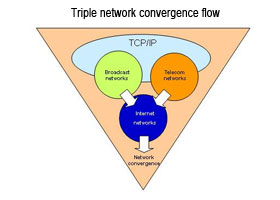
 The Chinese government has actively been pushing for the convergence of the country's three big networks - the Internet, telecom networks, and TV broadcasting networks - via various measures, most notably through the Triple Network Convergence Plan it laid out early in 2010. While the Triple Network Convergence Plan reiterates many government policies set out previously, one area that is expected to have significant effects on the market is the government's step to grant permission for TV broadcasting firms and telecom carriers to enter and do business in each other's realms.
China's State Council has listed accelerated triple network convergence as an important policy in 2010 and formulated a timetable and key milestones for such implementation. Local scholars estimate that triple network convergence will induce investment and consumption to the tune of 700 billion yuan (about US$103 billion), leading to widespread concern over the policy's effect on the development of related industries and various parties. In addition to its extensive coverage, China's Triple Network Convergence Plan also involves political entanglement, veiling its nature and importance.
This Digitimes Research Special Report examines China's Triple Network Convergence Plan from a macro and micro point of view. In addition to outlining triple network convergence details, Digitimes Research analyzes the effects the promoted policies will have on players in China's telecom and broadcast industries. The report also highlight the business opportunities and challenges triple network convergence will have on the development of services such as broadband, IPTV, connected TV, mobile TV, physical network infrastructure, among other areas.
Chart 1: Relationship between China's cable TV stations and municipal TV stations
Chart 2: State Council's push for accelerated triple network convergence
Chart 5: Internet users and broadband penetration in China (million)
Physical network infrastructure plans for telecoms and broadcasters
Business opportunities and challenges of triple network convergence
Chart 6: History of the development of triple network convergence
Table 1: The two phases and five core measures of China's Triple Network Convergence Plan
Chart 8: Industry eco-system before and after triple network convergence
Chart 10: User numbers in triple network convergence trial cities, 2009 (k units)
Table 5: Trial cities-Harbin, Changzhutan, Dalian, Mianyang and Hangzhou
Table 6: Trial cities-Shanghai, Wuhan, Xiamen, Shenzhen, Nanjing
Table 7: Fixed-network services provided by China's Top-3 mobile telecoms
Chart 13: China's broadcast and telecom service subscribers, 2009 (million subscribers)
Chart 14: Planned proprietary core and IXP network for China's broadcasters
Chart 16: China's accumulated online video users, June 2007-June 2010 (k users)
Table 10: Advantage/disadvantage of three major categories of online video operators
Table 11: Traditional Online Video operators - new deployment in 2010
Navigating the minefield: Advantages and Disadvantages of Local Broadcasters and Telecoms
Table 12: Advantage and disadvantage of broadcasting companies in online video market
Table 13: Advantage and disadvantage of telecoms in online video market
Chart 19: IPTV operations in place before the announced Triple Network Convergence Plan
Chart 20: China IPTV m arket breakdown, by region and provider, 2009
Table 14: China IPTV market breakdown, by region and provider, 2009 (k subscribers)
Chart 22: China IPTV subscriber forecast, 2009-2014 (k units)
Table 16: Comparison of different video services in terms of openness of supply chains
Chart 23: Connected TV vendors' Internet TV platforms and content providers
Chart 24: China monthly connected TV shipments, February 2009-March 2010 (k units)
Table 18: History of development of Internet TV and connected TVs in China
Chart 26: Breakdown of China's mobile TV users by delivery technology
Chart 27: Operational modes of handset-based TV services in China
