
China's economy started taking off under the economic reform championed by Deng Xiaoping in the 1980s, but the country's backward telecom infrastructure was unable to meet the needs of indigenous and foreign enterprises. In 1988, the State Council mapped out a direction for structural reform of the telecom industry. China's telecom industry used to be controlled by the government and monopolized by a single service provider, but in 1994, under the support of various ministries, China Unicom came into being, becoming the country's second nationwide enterprise for basic and value-added telecom services and breaking China Telecom's long-standing monopoly of the market. Since then, a few more waves of restructuring have taken place, creating a telecom market that now sees a three-horse race between China Telecom, China Mobile and China Unicom.
During the restructuring, China's telecom market has also entered the 3G era. The China government has issued 3G licenses to the three major telecom carriers, each of which embraces a different 3G standard. China Mobile, the largest mobile-phone operator of the country, was granted a 3G license featuring indigenous TD-SCDMA technology; China Telecom, a newcomer to the mobile-phone service, obtained a license for CDMA2000 EVDO; and China Unicom gained a license for WCDMA.
Looking at the overall development of 3G services in China since their launch, 2009 could be described as a period of infrastructure construction. Not only were base stations being deployed as service provision was rolled out to customers, but product supply chains for the TD-SCDMA, CDMA and WCDMA standards were also all far from robust; the upshot of this was that even if consumers were tempted to try out 3G services, they were faced with an annoyingly restrictive choice of handset terminals. Moreover, despite the fact that 3G services in China had been in planning for many years before their eventual launch, applied services capable of actually utilizing the advantages of 3G involved a considerable trade off in other respects for all three carriers during this initial period. Consequently, while the carriers made bold claims in 2009 about drawing in 30 million new 3G users during their first year of operation, this target was revised downward by the middle of the year, and the final number of 3G users by the end of 2009 was just 10.2 million.
However, as network deployment nears completion, the range of terminals increases and carriers begin to offer tariff plan support, DIGITIMES Research predicts that the number of 3G users in China will reach 44.8 million by the end of 2010, a threefold increase on the 2009 figure. With regard to the individual carriers, China Mobile is best placed to take the lion's share of China's 3G user base, as it has managed to obtain government policy support and is also in good shape in operational terms, with a range of relatively cheap tariff plans ready for launch.
DIGITIMES Research's latest Special Report, "China 3G telecoms, suppliers and market," traces the development of the telecom sector in the world's most populous country, and offers an in-depth analysis of the prospects of the 3G market.
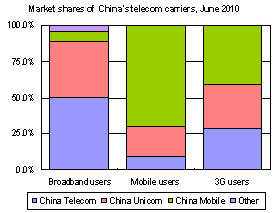
Chart 3: Market shares of China's telecom carriers, June 2010
Chart 4: Financial performance of China's telecom carriers, 1Q09 and 1Q10 (CNY m)
Chart 5: China's mobile user numbers by carrier, September 2008-June 2010 (m users)
Chart 6: Quarterly net increase in mobile users by carrier, 4Q08-2Q10 (m users)
Chart 7: Mobile business revenues and growth rates for China's 3 main carriers, 2009-1H10 (CNY m)
Chart 8: Mobile business ARPU for China's 3 main carriers, 2009-1H10 (CNY )
Chart 10: China Mobile's 3-year TD-SCDMA network expansion plan, 2009
Chart 11: China Telecom's 3G network expansion process, 2009
Chart 13: Investment in 3G network by China's telecom operators, 2009 (CNY b)
Chart 15: China Mobile's most heavily promoted terminals, 2009
Chart 17: China telecom operators' most heavily promoted 3G services, 2009
Chart 18: Focus of mobile network deployment for China's 3 main telecom groups, 2010
Chart 19: Focus of terminal strategies for China's 3 main telecom groups, 2010
Chart 20: Focus of 3G business promotion for China's 3 main telecom groups, 2010
Chart 21: Application store development for China's 3 main telecom groups, September 2010
Chart 22: Key future 3G competition strategies for China's 3 major telecom groups
Chart 23: Structure of the mobile phone supply chain in China
Chart 24: China 3G baseband chip market shipment projections for 2009-2013 (m units)
Chart 25: Shipments for China 3G baseband chip market by application, 2009-2013
Chart 26: Shipments for China 3G baseband chip market by technology, 2009-2013
Chart 27: China 3G baseband chip market share by shipments, 2009
Chart 28: Market strategies of new entrants to 3G baseband chip sector
Chart 29: Mobile telecoms technologies' market positioning and active expansion among chipmakers
Chart 30: Qualcomm deters new entrants to the WCDMA market with massive reductions in chip prices
Chart 31: Intel's acquisition of Infineon's wireless section
Chart 32: MediaTek enters WCDMA market, MStar and HiSilicon are watched closely by the market
Chart 40: Marvell leverages integrated SoC technology to move into the TD-SCDMA baseband chip market
Key mobile handset vendors in China; 3G terminal device supply chain by vendor type
Table 2: Major international manufacturers' current involvement in China 3G handset market
Table 3: Major China- and Taiwan-based brands' current involvement in China 3G handset market
Table 4: Samsung's 2010 launch of SPhone range in China covers all three 3G standards
Table 6: Nokia TD-SCDMA models launched during the 2009-2010 period
Table 8: RIM's Blackberry Storm 9530, customized for China Telecom
Chart 41: iPhone sold in China through China Unicom and Apple's own stores
Table 9: Key specifications and appearance of Lenovo's LePhone
Chart 42: Yulong Coolpad's deployment strategy for China market
Table 12: HTC officially launches 4 models for the China market in 2010
China 3G market scenario analysis and subscribers' forecast (2009-2014)
Chart 44: China 3G user base changes and predictions by carrier, 2009-2014 (m users)
Chart 45: Changes and predictions for overall proportion of 3G users in China, Taiwan and Japan
Forecasts for 3G mobile handsets by transmission type (2009-2014)
Chart 47: China's 3G handset market by transmission standard, 2Q09-2Q10 (k units)
Chart 48: China's 3G handset market by standard, 2009-2014 (m units)
