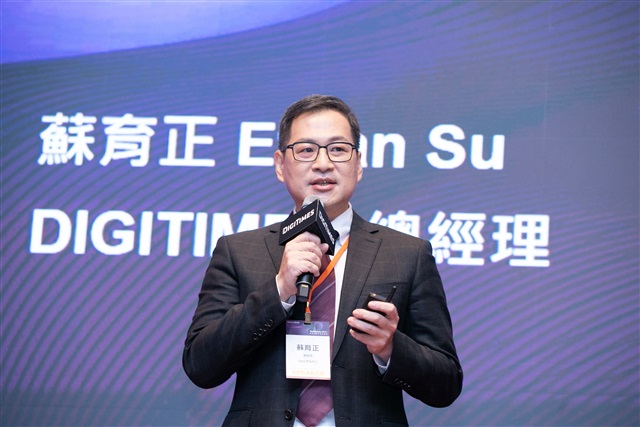
The DIGITIMES Tech Forum commences on December 3, drawing over 1,500 participants from the technology sector. The hybrid event spotlighted the industry's focus on global supply chain restructuring and accelerating artificial intelligence (AI) developments.
DIGITIMES president Ethan Su opened the forum by framing the industry's evolution, pointing to Nvidia surpassing Apple as the world's most valuable company as a clear signal of an AI-driven paradigm shift. While confidence remains in current order books, Su acknowledged concerns around geopolitical tensions and supply chain uncertainties. Taiwan's strategic role in this evolving landscape was identified as a critical issue for the technology industry going forward.
Reflecting on two decades of industry trends, Su traced how the composition of the top 10 companies by market capitalization illustrates shifts from the dot-com boom to commodity and energy demands driven by China, then to the dominance of mobile computing led by Apple. The rise of cloud service providers set the stage for the current focus on high-performance computing, now symbolized by Nvidia's market value supremacy. This transition reflects a broader transformation in computing architecture and supply chains beyond the success of individual firms.
The next wave of AI commercialization and supply chain realignment
Looking ahead to 2026, Su emphasized robust demand for high-end servers and AI-related products, with many firms holding orders extending two to three years. Despite economic uncertainties, especially due to US-China geopolitical tensions and complex supply chain challenges, industry momentum remains intact.
Su identified three primary challenges for the technology sector in the coming year. First is advancing AI commercialization beyond mere hype, focusing on transitioning AI capabilities from cloud platforms to edge devices and fostering tangible business applications. Drawing parallels with the internet era, technological progress is expected to underpin new business models.
Secondly, the ongoing US-China decoupling is reshaping global supply chains, prompting firms to build more resilient and geopolitically aligned production networks as the initial benefits of shifting orders to Southeast Asia and other regions stabilize. Thirdly, Taiwan's semiconductor and ICT industries remain indispensable to global supply chains. Maintaining technological leadership and strengthening ties with international partners will be essential as countries push for supply chain autonomy.
Outlook to 2029-2030 includes energy demand and emerging tech drivers
Su also looked beyond 2026, cautioning that early AI infrastructure-driven growth will plateau, necessitating innovation drivers toward 2029-2030. According to the DIGITIMES Research, focus areas will include AI-powered optical technologies described as the "battle of hundreds of lenses," thermal management solutions, green energy adoption, and the integration of 5G technology with satellite communications.
The data center industry's escalating computing power is fueling increased energy consumption and cooling requirements, with the thermal module market expected to grow at a compound annual growth rate (CAGR) of 22% between 2025 and 2030. Efforts to meet environmental, social, and governance (ESG) standards suggest that low-carbon energy sources will supply approximately 70% of global data center power by 2030.
Meanwhile, 5G adoption is projected to exceed 5.58 billion users worldwide by the end of the decade, and the satellite communications market is forecasted to expand at an 87.3% CAGR over the same period. Additionally, wearable AI devices such as smart glasses are anticipated to reach global shipments of 10 million units by 2027.
Concluding his remarks, Su outlined DIGITIMES' evolution as a technology media and research entity. With 28 years of experience, the organization aims to integrate its extensive digital news archives with AI tools to serve as a more intelligent information partner for clients navigating the fast-changing technology landscape.
Article edited by Jack Wu