When spine surgeons talk about pressure, few procedures rival C1–C2 fixation - a surgery so delicate that a deviation of just a few millimeters can mean the difference between success and catastrophic complications.
That reality became the starting point for NeuroSpine AI, a project developed by Sanny Kumar Sahani, a PhD researcher in computer science and commercial engineering, and Shweta Prajapati, a master’s student in biomedical engineering. Both are from India, both study at Chang Gung University, and both work in the same lab under the same advisor.
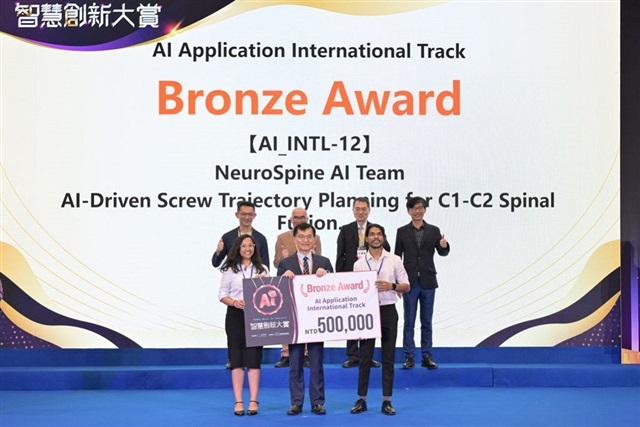
Their collaboration has earned them international recognition- the Bronze Medal at Taiwan's Ministry of Economic Affairs Best AI Award, standing out in a field crowded with enterprise and academic innovations.
Sahani recalls that during collaboration with Chang Gung Memorial Hospital, one experienced spine surgeon, Dr. Wu, described the mental burden of C1–C2 screw planning. Even for veteran surgeons, the risk remains high. The anatomy is complex, patient variation is significant, and the vertebrae sit dangerously close to the brainstem, nerves, and major blood vessels. If automation and precision could be applied anywhere in spine surgery, this was it.
Prajapati emphasizes that the motivation was never purely academic. Surgeons identified real constraints: planning is time-consuming, only highly experienced specialists can safely perform these procedures, and screw misplacement remains a serious clinical risk. The team's goal became clear - reduce planning time, lower dependence on elite expertise, and improve consistency without compromising safety.
Most existing surgical planning tools focus on the thoracic and lumbar spine. Those vertebrae are relatively uniform, making automation easier. C1 and C2, by contrast, are anatomically unique, highly variable, and structurally complex.
Sahani explains that current solutions either require extensive manual adjustment or do not support C1–C2 at all. NeuroSpine AI took the opposite approach: start with the hardest problem first.
The system automatically generates multiple screw trajectories, performs geometric safety checks, and ensures consistency regardless of who uses the software. Unlike manual planning - which varies between surgeons and depends heavily on experience - AI-generated trajectories remain stable and repeatable.
That consistency matters, especially for junior surgeons still building experience. The system does not replace surgical judgment, but it removes unnecessary variability from one of the most critical planning steps.
In traditional workflows, planning a single screw trajectory can take 30 to 60 minutes. NeuroSpine AI generates multiple trajectories in just two to three minutes.
More importantly, the system has been trained to understand the geometric patterns of C1–C2 anatomy, learning from diverse datasets collected through Chang Gung Memorial Hospital and an international collaboration in France. The AI does not simply segment images; its reason about spatial constraints, vessel proximity, and safe paths for screw placement.
The result is a pre-operative planning tool that balances speed, safety, and accuracy — something surgeons rarely get at the same time.
The role of AI is more Than just automation. First, it specializes exclusively in C1–C2 anatomy, rather than applying generalized spine models. Second, it performs geometric reasoning to avoid nerve and vessel damage - a non-negotiable requirement given the proximity to the brain. Third, it generates multiple alternative trajectories, ensuring that even abnormal anatomical cases still yield viable surgical options.
Prajapati notes that the system is designed for pre-operative use. Surgeons can review trajectories before entering the operating room, making the procedure safer and more predictable - particularly for less experienced doctors.
NeuroSpine AI has already completed initial clinical validation at Chang Gung Memorial Hospital, where surgeons confirmed that AI-generated trajectories aligned closely with what experienced clinicians would plan manually.
That validation marked a turning point. The project is now transitioning from research to a deployable product.
The next phase involves expanding beyond C1–C2 to cover the entire spine - all 26 vertebrae - and integrating the system into existing clinical workflow software. Given that C1–C2 is the most complex region, the team believes scaling to other vertebrae is both realistic and strategic.
The potential market spans hospitals, medtech companies, surgical planning platforms, robotic surgery firms, and spine implant manufacturers. As spine surgeries increase globally, automated pre-operative planning is becoming less optional and more essential.
The team plans to begin commercialization in Taiwan, leveraging established hospital partnerships, before expanding internationally.
For Sahani and Prajapati, participating in the Best AI Award was less about winning and more about validation. They wanted to know whether their work mattered beyond the lab - whether people outside academia could see its value. Winning the Bronze Medal provided that answer.
Prajapati admits they did not expect to win. The recognition, especially among international teams, gave them confidence that NeuroSpine AI is not only meaningful but scalable.
Both researchers express strong interest in continuing their work in Taiwan, citing the strength of its AI, biomedical, and hospital ecosystems. For Sahani, the integration between technology and healthcare feels unusually seamless.
Their roadmap is clear: expand anatomical coverage, refine clinical integration, and continue building AI systems with real-world medical impact.
As Prajapati puts it, the most meaningful part of the journey has been having a platform to explain how AI can truly help surgeons - not in theory, but in practice. And in a field where millimeters matter, that distinction makes all the difference.
NeuroSpine AI won the Bronze Award in the International Group AI Application Category at the 2025 Best AI Awards. If you have innovation would like to present, 2026 Best AI Awards with global tracks open for both AI Applications and IC Design, students and companies worldwide can compete for the grand prize of up to USD 30,000 (NTD 1,000,000). The deadline is March 16, 5:00pm (GMT+8). For more details, please follow official Linkedin for the lastest updates.