
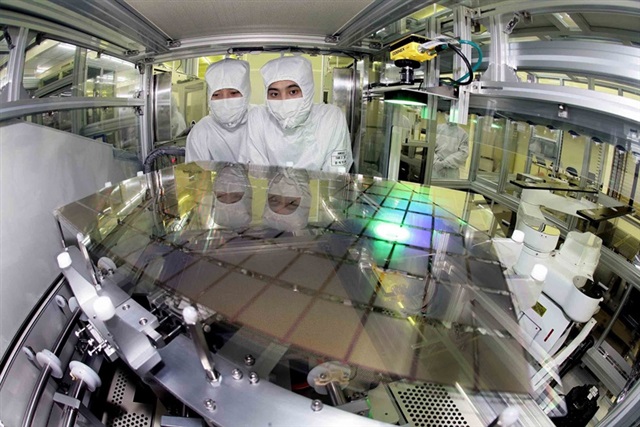
Semiconductor manufacturers are racing to secure critical materials as Middle East tensions disrupt supply chains, with the risk of production disruption outweighing rising costs.
Procurement teams at Samsung Electronics, SK Hynix, and DB HiTek are conducting daily checks on the availability and pricing of key inputs to head off potential disruptions, according to South Korean media The Elec.
Helium supply risks intensify
Helium has emerged as the most immediate concern, given its essential role in semiconductor manufacturing, including plasma etching, deposition processes, and wafer cooling.
The gas is a byproduct of liquefied natural gas production, with Qatar accounting for roughly one-third of global supply. According to The Elec, attacks linked to Iran on Qatar's Ras Laffan industrial complex have damaged LNG facilities, reducing export capacity by about 17%, with recovery expected to take three to five years.
Spot helium prices have risen by more than 50%, according to industry sources cited by The Elec.
Tightening helium supply has already begun affecting parts of the global technology supply chain. Executives said companies are scrambling to secure alternative sources, with few short-term options beyond slowing output or prioritizing key products.
The Wall Street Journal also reported that disruptions linked to the conflict could significantly reduce helium deliveries, underscoring the gas's role in cooling and stabilizing advanced chip manufacturing equipment.
Petrochemical materials costs climb
Beyond helium, other semiconductor materials tied to petrochemical feedstocks are also rising as crude oil and naphtha costs increase.
Thinner, ethanol, and isopropyl alcohol (IPA), which are widely used in wafer cleaning and post-etch residue removal, are directly linked to upstream petrochemical pricing. Industry data cited by The Elec shows that propylene oxide prices have risen by more than 40% since early March, driving up costs for downstream chemicals including PGME and PGMEA.
Major suppliers, including DuPont, Dow, and LG Chem, have issued price hike notices to downstream manufacturers. Finished thinner products are expected to rise by about 20% starting in April, according to industry sources.
Ethanol prices are also set to increase by around 10% as suppliers begin passing through higher naphtha costs. IPA prices are expected to follow, though final adjustments have yet to be confirmed.
Production continuity outweighs cost concerns
Despite rising material costs, the direct impact on chip pricing is expected to remain limited, as these inputs account for a relatively small share of total production costs.
The greater concern is the risk of supply disruption if geopolitical tensions persist. Executives warned that prolonged shortages could force production slowdowns or, in extreme cases, temporary shutdowns, with potential ripple effects across electronics, automotive, and other downstream sectors.
Some suppliers have indicated stable access to US-sourced helium, while companies with heavier reliance on Qatari supply face greater pressure. Alternative sourcing options exist, including from Russia, though geopolitical constraints limit their viability.
Industry participants said major chipmakers are building inventory at prevailing market prices to lock in supply as uncertainty in global materials markets grows.
Credit: DIGITIMES
Article edited by Jack Wu