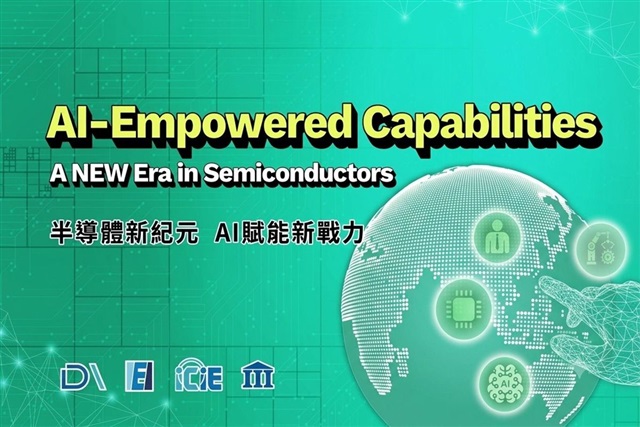
The integration of artificial intelligence into the semiconductor industry is no longer merely a competitive advantage - it has become a core driver of modern engineering.
The Industrial Development Administration (IDA) under Taiwan's Ministry of Economic Affairs is committed to building a comprehensive training and support ecosystem for international talents in Taiwan. The initiative covers key semiconductor technologies, cross-cultural communication, and local integration, while also leveraging online learning resources to connect talent across the Asia-Pacific region.
Designed to help outstanding international students and professionals transition seamlessly into Taiwan's semiconductor industry, the program provides early exposure to the local industrial ecosystem, along with mentorship and tailored support services that strengthen long-term adaptation, professional growth, and career development in Taiwan. Through these efforts, Taiwan aims to cultivate a more inclusive and globally connected environment for international talent, further enhancing the global competitiveness of its semiconductor industry.
Through specialized talent development programs in Taiwan, Wifal Inola from Indonesia and Earon John Mendoza from the Philippines are transforming their professional capabilities and expanding their roles in the global semiconductor ecosystem.
By bridging the gap between theoretical AI knowledge and its practical application in high-tech manufacturing and research and development, these programs are cultivating a new generation of interdisciplinary talent prepared for the future of advanced technology industries.
Advancing technical depth and specialized application
The training provided in Taiwan offers a significant shift in both technical depth and industrial focus compared with the educational experiences available in the engineers' home countries.
Wifal Inola, a master's student in the Department of Semiconductor Technology at National Yang Ming Chiao Tung University (NYCU), observed that while AI training in Indonesia often focuses on supporting the digital economy through e-commerce and financial technology, Taiwan's curriculum is deeply rooted in advanced semiconductor applications and system integration. This includes specialized fields such as smart manufacturing, medical technology, and robotics.
Similarly, Earon John Mendoza, a QW1612 Assistant Engineer at ASE and a post-baccalaureate student at I-Shou University, emphasized that AI-related training in Taiwan is far more structured and technically rigorous. He noted a clear contrast with his previous educational experience in the Philippines, where the focus was often placed on final output and task completion under pressure.
In Taiwan, however, the emphasis is placed on understanding every step involved in building AI models - ensuring engineers understand not only how a process works, but why each stage is necessary. This foundational approach is especially critical in semiconductor manufacturing, where skipping steps in troubleshooting or equipment maintenance can lead to serious systemic failures.
Enhancing efficiency through AI tools in R&D and manufacturing
Both engineers have successfully integrated AI tools into their daily workflows, reducing manual workloads and allowing greater focus on high-value technical decision-making.
Wifal Inola, who secured both an internship and a future full-time position at Micron as a Process Engineer in Diffusion Process, uses AI to streamline the demanding research process required in semiconductor studies. He applies AI tools to significantly reduce the time spent on literature reviews, allowing him to quickly understand unfamiliar research topics.
He also leverages AI for technical analysis tasks such as X-ray Photoelectron Spectroscopy (XPS) peak division and chemical bond identification. By delegating repetitive analytical work to AI, Wifal is able to focus more on designing better experiments and optimizing process parameters.
In the industrial sector, Earon applies AI knowledge within ASE's preventive maintenance operations to ensure production lines remain stable and efficient. His work focuses on hardware-related systems such as sensors, controllers, and equipment monitoring.
In an environment where every minute of machine downtime translates into significant production losses, AI becomes a critical tool for operational efficiency. Earon uses AI-assisted inspection systems and computer-based monitoring tools to track equipment failures and identify non-good (NG) parts with high precision.
His background in mechatronics, combined with AI training, allows him to better understand how different hardware components interact - helping him identify faster and more effective solutions while improving productivity beyond standard performance targets.
Localized AI development beyond manufacturing
Beyond hardware and manufacturing applications, both Taiwan and other countries are also developing localized AI models to better serve their own linguistic and cultural environments.
Wifal noted that Taiwan has developed TAIDE (Trustworthy AI Dialogue Engine), which focuses on traditional Chinese language applications and local cultural context. At the same time, Indonesia has introduced Sahabat AI, a model designed specifically for Bahasa Indonesia and regional dialects.
This development highlights that AI training is not solely about meeting global technical standards - it is also about understanding how technology can be adapted to serve local populations more effectively.
The future: from manual labor to strategic decision-making
Both engineers believe AI will fundamentally reshape the semiconductor industry over the next five to ten years. Wifal believes AI will eventually take over most repetitive and manual tasks, shifting the role of engineers toward high-level decision-making based on AI-assisted analysis and predictive systems.
This transformation will require a new type of professional - one who combines deep semiconductor expertise with strong capabilities in data analysis and AI fundamentals.
Earon shares a similar view, expecting AI to become a key solution for reducing time-consuming and physically demanding tasks that engineers currently perform manually. This will allow professionals to focus more on solving complex technical challenges and driving innovation.
As AI continues to automate repetitive work and redefine traditional engineering roles, the experience gained in Taiwan ensures these professionals remain at the forefront of industry transformation.
Whether they return to their home countries or continue their careers at world-class companies such as Micron and ASE, they carry with them the technical depth, operational efficiency, and strategic mindset needed to lead AI-integrated engineering teams.
Ultimately, this talent exchange creates a true win-win scenario: Southeast Asian engineers gain access to world-class career opportunities, while the global semiconductor industry benefits from a more resilient, technically sophisticated, and future-ready workforce.
A new era of global synergy
The stories of Wifal Inola and Earon John Mendoza reflect a broader shift in the global semiconductor landscape - one where talent mobility and specialized AI training are becoming key drivers of innovation.
By opening its doors to engineers from Indonesia and the Philippines, Taiwan is doing more than addressing talent shortages. It is fostering an advanced ecosystem of professionals who are fluent in both semiconductor engineering and artificial intelligence.
For the engineers themselves, the journey is transformative - turning them into interdisciplinary leaders capable of navigating the growing complexity of modern manufacturing, process optimization, and R&D.
As the semiconductor industry becomes increasingly AI-driven, these talent development programs are ensuring that the next generation of Southeast Asian engineers is not simply adapting to change - they are prepared to lead it.