
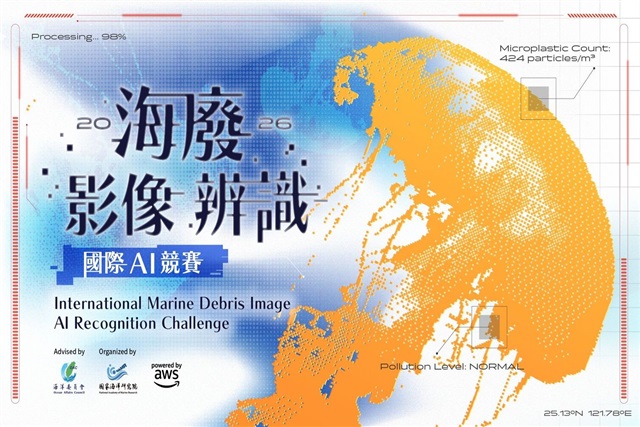
Marine debris management is entering a new phase of data-driven applications. Converting years of accumulated coastal imagery into actionable tools for surveying, identification, and monitoring has emerged as a critical challenge in the digitalization of ocean governance.
Under the guidance of Taiwan's Ocean Affairs Council (OAC), the National Academy of Marine Research (NAMR) is hosting the "2026 International Marine Debris Image Recognition AI Challenge." Featuring a dataset of over 20,000 real-world marine debris images, the competition invites AI, data science, computer vision, and marine science teams from Taiwan and abroad to participate.
The competition is supported by Amazon Web Services (AWS) as the AI technology partner, with model evaluation and competition operations managed through the Industrial Technology Research Institute's (ITRI) AIdea AI Co-Creation Platform. Registration is now open.
NAMR sets the challenge: bringing AI to the frontlines of ocean governance
Marine debris has long been a fundamental issue in coastal environmental governance - and one of the most difficult to address in the field. Coastal debris is diverse in type, scattered in distribution, and frequently degraded by sun exposure, seawater erosion, sand burial, and physical damage, making manual surveys and image interpretation highly labor- and time-intensive.
To accelerate digital transformation, NAMR has established MDImageNet, an AI-Ready marine debris image dataset covering the ICC19+1, NAMR26+1, and NAMR33+1 marine debris category schemes. The competition draws on NAMR's existing marine debris image dataset, comprising over 20,000 images annotated with YOLO-format bounding boxes. The dataset covers common coastal waste categories including plastic litter, fishing-related debris, and other anthropogenic waste.
A "post-mapping" strategy is adopted: participants first train models using the original class labels provided, then map predictions into 20 official recognition categories during inference, with final scoring based on 19+1 primary marine debris target classes.
The competition design confronts teams with the real-world constraints of field data - cluttered backgrounds, diverse object classes, and significant appearance variations. By requiring quantitatively evaluated object detection models, the challenge goes beyond open data sharing: it validates whether AI can be transformed into deployable tools built upon existing survey infrastructure.
The competition comprises preliminary and final rounds, evaluated primarily on mean Average Precision (mAP) at an IoU threshold of 0.5. A "Best Lightweight Optimization Award" is also offered, using NetScore to balance detection accuracy, model size, and computational complexity-encouraging models suitable for practical deployment in coastal patrols, UAV-based image analysis, and long-term environmental monitoring.
AWS cloud resources and AIdea platform power hands-on AI development
The competition integrates resources from AWS and ITRI's AIdea AI Co-Creation Platform to support teams throughout model development, training, testing, and evaluation. AWS provides the cloud development environment, offering Amazon SageMaker AI and computing resources for machine learning workflows. Technical workshops are also scheduled to familiarize participants with cloud-based AI development tools and model training pipelines.
ITRI's AIdea Platform handles competition execution, dataset support, and automated scoring. The standardized cloud environment and evaluation framework ensures all teams operate under identical conditions, maintaining fairness and reproducibility.
The competition is open to high school students, college students, and professionals, with teams of two to five members. Cross-institutional and interdisciplinary collaboration is encouraged, combining expertise in AI, computer vision, data science, and marine science to produce evaluated model outcomes for marine debris recognition.
Registration for the "2026 International Marine Debris Image Recognition AI Challenge" is open until August 10. The total prize pool is NT$300,000, with two additional Best Lightweight Optimization Awards.
NAMR aims to bring together the AI community, research institutions, academia, and industry to convert marine debris imagery into deployable environmental monitoring models-building Taiwan's AI application experience and marine data foundation for ocean governance.
For competition details and registration, visit the official website (link).