Entering a location on a job search platform may seem like a simple filter, but the results are often strictly bound by administrative borders. A job opening in a neighboring district might actually offer a much shorter commute than one within the selected area, yet it gets excluded simply due to arbitrary municipal boundaries.
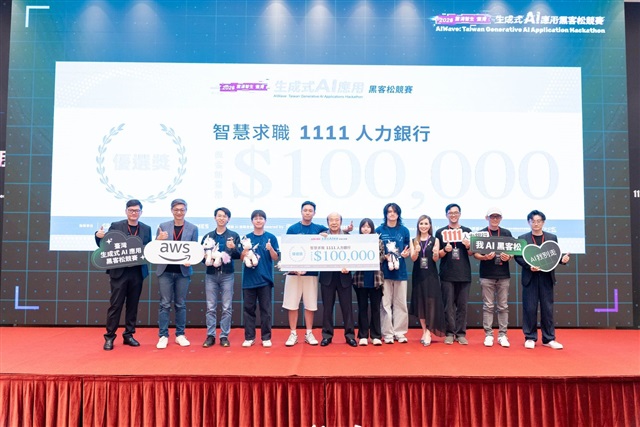
Addressing this exact friction point, team "Binary Search Cannot Find the Future"—competing in the 1111 Job Bank: Smart Job Search track at the 2026 Taiwan Generative AI Applications Hackathon—developed an innovative solution combining geographic and skill graphs to make job searches closely mirror real-world commuting habits. The hackathon was organized by DIGITIMES under the guidance of the Administration for Digital Industries (ADI), Ministry of Digital Affairs (MODA). Amazon Web Services (AWS) served as the AI technology provider, delivering the generative AI and cloud services that powered the solutions.
Bridging district boundaries with GeoGraph
The team initially drew inspiration from the "Skill Graph" concept outlined in 1111 Job Bank's challenge statement, using it as the foundation for their Minimum Viable Product (MVP) before expanding into spatial intelligence. The team observed that conventional job search, booking, and travel platforms rely heavily on administrative divisions for indexing. Once a user specifies a region, the platform strictly returns results within that boundary. While efficient for database categorization, this approach fails to account for actual spatial proximity, leaving job seekers near district borders blind to closer, more convenient opportunities just across the line.
To overcome this limitation, the team introduced GeoGraph, a spatial location graph that models adjacent regions using a graph network structure. When suitable job openings are scarce within a target district, the system automatically expands its query to surrounding areas based on geographic topological relationships rather than hard municipal borders. The objective is not merely to increase search volume, but to deliver recommendations that align with job seekers' real-world commuting intuition and bridge information gaps caused by rigid administrative tagging.
Deploying LLMs for non-standard, intent-driven queries
Beyond spatial constraints, the team tackled the inherent limitations of traditional keyword matching in interpreting colloquial and non-standard expressions. By combining Large Language Models (LLMs) with targeted system prompts, the platform performs semantic reasoning to translate casual phrasing, abbreviations, or composite requirements into searchable professional skill concepts. For instance, while keyword algorithms struggle with informal phrasing, the LLM infers intent—mapping queries to logistics, e-commerce, or last-mile delivery roles—and retrieves relevant openings accordingly.
Navigating tight competition timelines and computing budgets required strategic engineering trade-offs. Managing simultaneous multi-developer deployments introduced environment and version control challenges. Furthermore, passing every job listing through LLMs for skill extraction would have severely inflated API costs and latency. To optimize performance, the team implemented a hybrid architecture, using conventional Natural Language Processing (NLP) for baseline data preprocessing while strategically deploying generative AI where it added maximum value.
The team emphasized that while AI tools have become ubiquitous, true competitive differentiation stems from precise problem definition, robust data engineering, and system architecture design. Looking ahead, integrating real-time traffic data, transit routes, and actual commute times will make job recommendations even more aligned with everyday decision-making, unlocking the full commercial potential of GeoGraph.