
Google's open approach to Android's source code has enabled the operating system (OS) to grow rapidly in the smartphone market. Virtually all market research carried out on the subject shows that Android became the number one mobile OS by market share in 2010 or 2011, with shipments of devices running second-place iOS less than half the figure for Android.
Google's open policies may have helped Android to take the top spot in the market, but they are also a potential weakness of the platform. Some vendors have made modifications or additions to the functionality and interface of Android out of concern that the plain "vanilla" version of the OS was not sufficiently competitive with iOS or other mobile platforms in these areas. These modified versions in some cases already diverge significantly from standard Android, and can therefore be regarded as Android variants or "mods."
Besides competing with non-Android platforms, Android handset vendors' other primary motivation for modifying Android is the desire to make their products more competitive and distinctive within the Android market itself. The use of modifications to Android as a means to differentiate products also extends to telecom carriers and ecommerce companies who aim to use such modifications to expand the size of their original businesses and increase profits.
There are also pure enthusiast "mods," as well as variants created by smaller companies and startups hoping that their own distinctive modifications will allow them to achieve more rapid growth in the crowded smartphone market.
So are modifications to Android a good thing or a bad thing for the Android ecosystem as a whole? Do they create new markets that do not conflict or overlap with the original, official Android OS, or do they make the official Android market more chaotic and sow the seeds of future problems in the development of Android as a whole? Moreover, what is Google's view of these variant versions of Android? On the one hand, Android variants could bring models and ideas for new functions and features, but on the other hand could weaken Google's hold over app developers and eventually end users.
Even more importantly, the majority of commercially-oriented Android variants were created by companies in China. A key question is therefore whether Android variants can repeat the industry-changing success of China's white-box handset industry.
Chart 1: Possible effects of the development of Android variants
Chart 3: B&D uses a version of Android heavily modified to meet its needs
Chart 4: Android become less chaotic as vendors begin to concentrate on a small number of versions
Commercial opportunities for Android variants gather momentum
Five main technological levels for Android variant development
Chart 5: Five main technological levels on which Android variants are being developed
Table 1: Potential benefits of modifying Android's core functionality layers
Chart 7: Timeline of the development of the major variant Android operating systems
Table 2: Main differences between commercial and non-commercial variants of Android
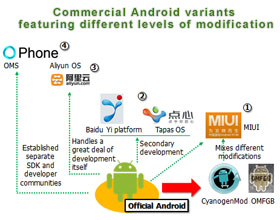
Chart 8: 4 commercial Android variants featuring different levels of modification
The bottom line for variants and modification: app compatibility
Chart 9: Scope of modifications to Android's interface and functionality
Chart 11: Relationship between the Android SDK and digital publishing platforms
Challenges posed by the current policies of the Android Market
Table 3: Comparison of Apple and Google's digital publishing platforms
Table 4: Creation of separate Android SDKs and publishing platforms by companies other than Google
Chart 12: OPhone OS supports many of China's localized technical standards
Table 5: Release dates and Android compatibility for various versions of OPhone
Table 6: Number of branded handsets supporting different versions of OPhone OS
Chart 14: Tapas OS' likely marketing strategy for the after market sector
Chart 16: Lenovo's Le range - tools, OS, hardware, platforms and services
Table 7: Comparison of Lenovo's "Le" solutions and Apple's "i" solutions
Table 8: Comparing the conditions of usage for Lenovo LeCloud and Apple iCloud
Chart 19: MIUI's two-track development of new feature builds and stable versions
Chart 20: Features of Baidu Yi's accompanying cloud services
Chart 22: Aliyun OS uses a cloud-based SDK and environment for app development
Chart 23: LeWa has opted to undercut the price of many other Android variants on the market
Chart 24: LeWa Tek's strategy avoids directly providing customized engineering
Chart 25: Timeline of Meizu Technology's product development
Chart 27: Meizu's Flyme Store imitates the download number thank you messages on Apple's App Store
Chart 29: China's Android variant handset shipmentss, 2011-2012 (k units)
