
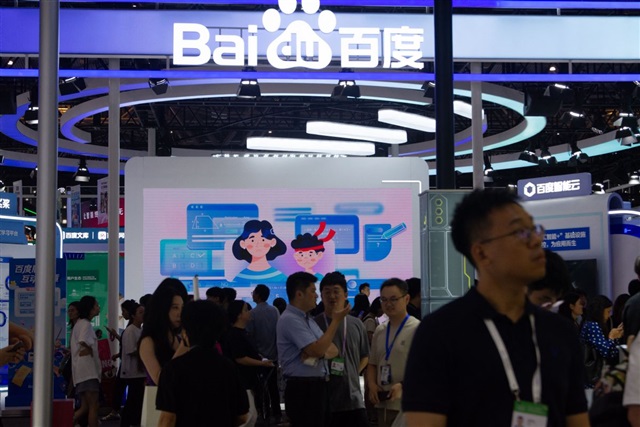
Following the US ban on sales of Nvidia's high-end chips to China, expectations have grown that Baidu could rapidly emerge as a new force in China's AI chip sector and become the country's second major source of domestic compute capacity after Huawei.
CNBC reports that Deutsche Bank identifies Baidu's Kunlun unit as a leading developer of high-performance AI chips in China, with products centred on large language model training, cloud computing, telecoms, and enterprise use cases.
JPMorgan estimates that Baidu's chip sales could rise sixfold to about US$1.1 billion in 2026, while Macquarie projects a valuation of US$28 billion for Kunlun.
Barron's notes that under global chip restrictions, Chinese companies cannot obtain high-end Nvidia GPUs and, without in-house options, must compete for limited lower-tier supply. Baidu has consequently built its own capabilities, ranging from chip development to server integration and supernode systems.
Reports also indicate that Beijing authorities have urged Chinese firms not to use Nvidia's H20. Huawei operates large compute clusters but with constrained availability, while Kunlun chips have already been adopted by China Mobile, the country's largest telecom operator, raising Baidu's profile in China's domestic substitution wave.
The Futurum Group states that Baidu's chip strategy is shaped by both necessity and opportunity. If Kunlun's next-generation chips reach mass production as planned, Baidu could stabilise its own compute supply and position itself as a key provider within China's AI industry.
At the Baidu World conference on November 13, the company announced plans to introduce the Kunlun M100 in 2026 and the Kunlun M300 in 2027, along with a five-year technology roadmap. Kunlun chips already support Wenxin LLM workloads in Baidu's data centres and are sold, along with cloud compute resources, to external customers.
Baidu CEO Robin Li said at the event that the AI industry's value structure has long been unbalanced and unhealthy, with chipmakers capturing most of the value while model development and application layers gain little. He added that this imbalance is one reason Baidu has had to pursue its own chip development.
Article edited by Jack Wu