
Global 5G penetration is expected to overtake 4G in 2027 to become the dominant network technology, according to the latest Mobility Report from Ericsson. In addition to this pivotal milestone in mobile communications, the report also points to the beginning of the standardization process for 6G, which is expected to reach 180 million users by 2031, with advanced markets such as the US, China, Japan, and South Korea leading the way in terms of adoption.
The report also notes that Taiwanese telecom operators have started testing differentiated connectivity services in certain use cases, such as streaming live entertainment and events. Commercial 5G standalone (SA) services are expected to commence in one to two years.
Northeast Asia ranks second globally in 5G penetration; SA slicing key for revenue growth
As noted in the report, as of the third quarter of 2025, global 5G subscriptions increased by 162 million, with total users expected to reach 2.9 billion by year-end, accounting for one-third of all mobile users. Global 5G penetration is forecasted to exceed 4G in 2027 to becoming the dominant mobile technology. By 2031, 5G users will surpass 6.4 billion, or two-thirds of mobile subscribers worldwide. In addition, Northeast Asia (including Taiwan) has achieved a 61% 5G penetration rate, ranking second globally after only North America.
With the expansion of 5G coverage, telecom operators are accelerating fixed wireless access (FWA) deployments. FWA connections are projected to hit 350 million by 2031, with the Asia-Pacific region accounting for half of this total. Currently, 81% of operators worldwide offer FWA services, of which more than half provide speed-based plans.
However, telecoms now face challenges in boosting revenues. Among the roughly 360 operators offering commercial 5G services worldwide, over 90 have launched or trialed 5G SA services offering user-centric differentiated connectivity that replaces traditional "one-size-fits-all" models. Of the 79 operators that have deployed commercial 5G SA, 56 utilize network slicing for differentiated services, with 65 distinct commercial offerings already available.
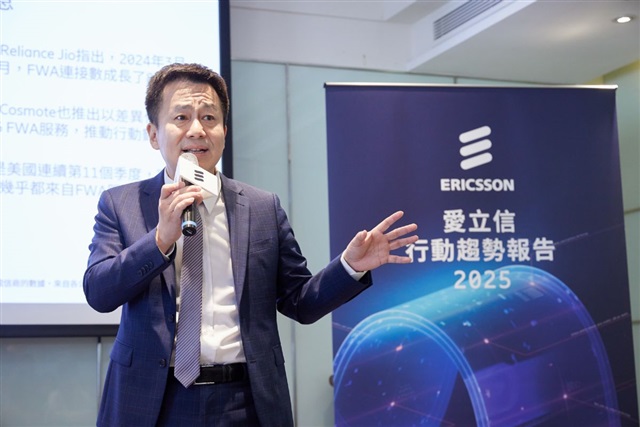
According to David Chou, president of Ericsson Taiwan, differentiated connectivity is critical for monetizing 5G, driving market growth through new business models. With the maturation of 5G SA technology, SA deployment will become a necessary step in the evolution toward 6G. Continued development of 5G capabilities will also fuel potential in the FWA market, which serves as an alternative to fixed broadband in offering fast service and activation for remote areas, older housing, or rental environments.
Increased uplink demand from AI drives shift in network traffic
Mobile data traffic has grown alongside 5G user numbers: the report projects annual net growth in mobile data volume to hit a new record high in 2025, driven primarily by the growing number of smartphone users and increased video consumption. Video traffic is expected to account for 76% of total mobile data volume by the end of 2025, with short-form content dominating usage.
Moreover, uplink traffic has become crucial for enterprises adopting generative AI, as this requires continuous, secure connectivity for real-time cloud access. The trend also highlights the crucial role that telecoms play in the planning of network capacity planning, spectrum allocation, and the development of radio access network (RAN) functionality.
AI-RAN enables smart networks; 6G to adopt SA architecture
AI-powered RAN (AI-RAN) is seen as a key transitional technology in the lead-up to 6G commercialization. According to data from Ericsson and its telecom partners, AI-RAN implementation can improve spectral efficiency by 10%, user throughput by 20%, and energy efficiency by 33%.
According to Ericsson Taiwan CTO Dann Yao, AI-RAN is a key strategic direction for the telecom industry, serving as the core for 5G and 6G smart networks. By integrating AI with intent-driven networking, operators will be able to rapidly achieve business goals, accelerate new services, and lay the foundations for sustainable operations and innovation in the future by gradually moving toward highly automated and smart networks.
Looking ahead, the report predicts that 6G will adopt an SA architecture evolved from 5G SA core networks, while incorporating new capabilities such as AI and integrated sensing and communication (ISAC). This will define a new RAN framework that fully supports existing 3GPP bands, while enabling spectrum sharing between 5G and 6G.
Article edited by Jack Wu