CONNECT WITH US

Taiwan reveals NT$1.25 trillion defense plan, targets 200,000-drone force

Chloe Liao, Taipei; Sherri Wang, DIGITIMES Asia 0

Credit: DIGITIMES

Taiwan's Ministry of National Defense has released select non-classified details of a special military procurement package totaling NT$1.25 trillion (approx. US$39.5 billion), offering a clearer picture of a strategic shift from conventional warfare toward technology-driven operations.

A review of the disclosures reveals a significant increase in demand for unmanned systems and a greater emphasis on AI, including plans to expand drone procurement to as many as 200,000 units.

Three strategic pillars

Following a closed-door briefing at the Legislative Yuan on January 19, the ministry outlined portions of the procurement plan that can be made public. The submitted report organizes the spending and strategic priorities around three pillars.

The first focuses on building a layered, high-technology air defense network, described by officials as a "Taiwan Dome." The second centers on accelerating the adoption of advanced technologies and AI to speed command transmission, improve precision-strike capabilities, shorten decision-response times, and enhance kill chain efficiency through AI-assisted operations.

The third pillar targets the development of Taiwan's domestic defense industry, emphasizing indigenous research and development and technology transfers to ensure supply chains remain free of so-called "red" suppliers linked to China.

Procurement categories highlight unmanned systems

Within the NT$1.25 trillion package, the ministry identified seven major procurement categories. These include precision artillery, long-range strike missiles, air defense, anti-ballistic and anti-armor missiles, AI-enabled systems and C5ISR, as well as unmanned platforms and countermeasure systems.

While some spending remains directed toward traditional weapons, the most notable expansion is in unmanned systems tied to new combat concepts. The ministry outlined requirements that exceed earlier planning assumptions.

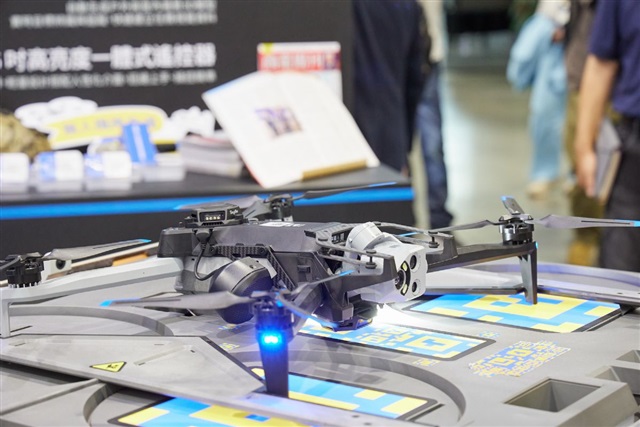
Beyond the purchase of 2,000 ALTIUS drones from US suppliers, the plan calls for roughly 200,000 drones deployed domestically across multiple categories, including intelligence, surveillance, and reconnaissance platforms and attack variants such as dive-attack, bomb-dropping, and suicide drones. The package also includes more than 1,000 unmanned surface vessels.

The scale represents a fourfold increase from the 50,000 drones previously planned by the Armaments Bureau by the end of 2025.

Drones treated as consumables

The renewed surge in drone demand reflects expectations for future battlefield consumption, according to the ministry's report.

Defense officials said the use of drones and precision munitions in future conflicts is likely to far exceed earlier estimates. As a result, drones are expected to shift from reusable platforms to expendable munitions, requiring mass production similar to traditional ammunition. Officials added that procurement volumes could rise further.

One example is first-person-view (FPV) attack drones, which have demonstrated combat effectiveness in recent conflicts, including the war in Ukraine and fighting between Israel and Hamas. These systems are increasingly viewed as frontline battlefield assets.

Implications for Taiwan's supply chain

Industry observers familiar with the defense sector said the military's move to sharply increase drone quantities points to a strategy centered on swarm tactics, emphasizing numerical advantage and low-cost operations. That approach is seen as a clear positive for Taiwan's domestic drone manufacturers and related supply chains.

Drone supply chain companies said overseas procurement remains focused on higher-cost platforms, such as cruise missile-like systems and loitering munitions. FPV drones, by contrast, are low-cost, single-use munitions that require rapid replenishment and flexible production lines, making them better suited to local manufacturing and creating more opportunities for Taiwanese suppliers.

For Taiwan's domestic industry, a key issue is how much of the NT$1.25 trillion budget will be spent locally rather than on foreign purchases. The defense ministry has previously confirmed that about NT$300 billion is expected to be produced domestically, with the remaining NT$900 billion-plus allocated to overseas procurement.

Article edited by Jack Wu