
CONNECT WITH US

London stakes its claim as the financial Launchpad of the space age

Elaine Chen, DIGITIMES Asia, London 0

Credit: DIGITIMES

For more than three centuries, the London Stock Exchange helped bankroll the industries that defined their eras, from the railways that stitched together 19th-century Latin America to the oil and mining conglomerates that powered the 20th century. Now, as the global economy turns skyward, London's financial establishment is preparing to finance what could become its next great industrial chapter: the US$1.8 trillion space economy.

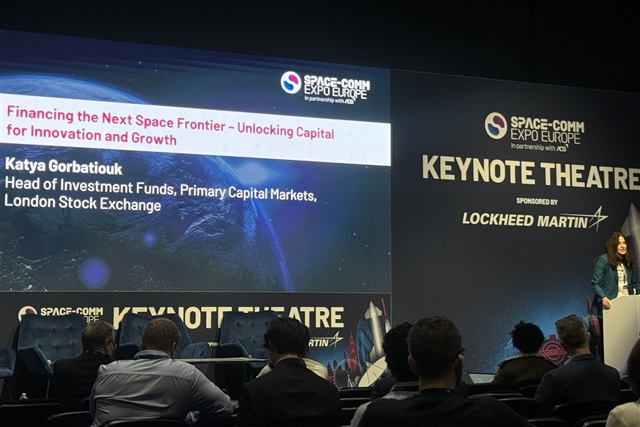
Speaking at Space-Comm 2026, Katya Gorbatiouk, head of investment funds in primary capital markets at the exchange, argued that space has outgrown its reputation as a speculative frontier. It is no longer a niche pursuit of billionaire hobbyists or government agencies, she said, but "critical economic infrastructure", as foundational to modern life as railways once were.

Satellites now underpin global telecommunications, climate monitoring, navigation systems, and military security. Advances in microgravity research are beginning to influence biotechnology and materials science. What was once experimental is becoming industrial.

But industrialization requires capital and in quantities that private markets alone may struggle to supply.

Push to close growth capital gap

London's answer, Gorbatiouk said, is a sweeping modernization of its capital markets aimed at closing Britain's long-lamented "growth capital gap."

Despite overseeing more than GBP3 trillion (approx. US$4 trillion) in pension assets, British retirement funds allocate just a sliver — roughly 0.07% — to venture capital. The imbalance has long frustrated policymakers who argue that promising domestic companies are too often forced to look abroad for scale-up funding.

Under the Mansion House Accord, the financial sector is pressing for a cultural and regulatory shift that would channel at least 10 percent of pension assets into private markets, with half directed toward British growth companies. The goal is not merely incremental change, but a structural reallocation of long-term capital toward innovation-heavy sectors such as space.

To accommodate this shift, the exchange has embarked on what Gorbatiouk described as a "relentless reform agenda." Listing requirements have been eased. Dual-class share structures — once viewed skeptically in London — are now permitted, allowing founders to retain greater control. Larger, fast-growing companies can access major indices more quickly.

Perhaps most notably, the exchange has introduced a Private Securities Market, a regulated venue that allows private companies to offer liquidity to early investors and employees without undertaking a full public listing. The initiative is designed to create what officials call a "funding continuum," smoothing the path from early-stage venture backing to public market scale.

Permanent capital for a long-term industry

Space ventures present a particular challenge to conventional investors. Rocket development, satellite constellations, and orbital infrastructure often require years of research and billions in upfront investment before generating predictable revenue.

For that reason, London is championing the use of listed investment companies: publicly traded, closed-ended funds that provide permanent capital. Unlike open-ended funds, they are not subject to sudden investor redemptions, making them better suited to industries with long development cycles.

The structure would allow institutional and retail investors alike to buy into diversified portfolios of private space companies, gaining liquidity without starving those companies of the capital required for sustained research and development.

Digitizing access to private markets

The ambition extends beyond traditional equity financing. In partnership with Microsoft, the London Stock Exchange Group is developing digital market infrastructure to enable tokenized units of private funds. This move could streamline global investor access and reduce friction in cross-border capital flows.

If successful, such technology would allow strategic industries to raise capital at digital speed, rather than through the slower mechanisms that have long defined private markets.

A financial center's next test

For London, the effort carries significance beyond a single sector. Since Brexit, the City has faced mounting pressure to reaffirm its role in global finance. Funding the industries of the future — AI, clean energy, and space — may prove central to that effort.

"The sky is quite literally the limit," Gorbatiouk said in closing. "We can no longer afford to underinvest in the space economy."

Whether Britain's pension trustees and global investors will embrace that vision remains to be seen. But as the commercial space race accelerates, London is making clear that it intends not merely to watch from Earth — but to finance the launch.

Article edited by Jack Wu