
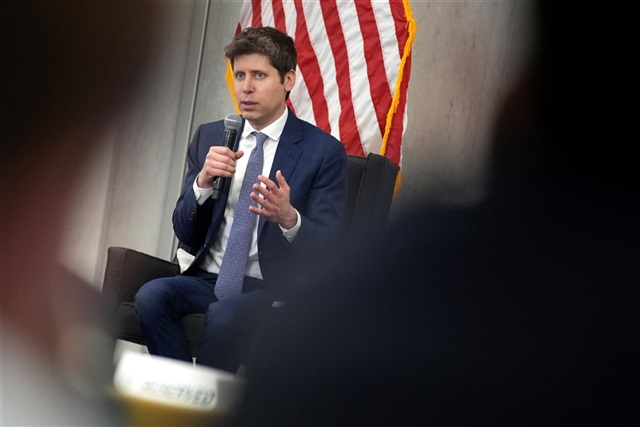
The San Francisco home of OpenAI CEO Sam Altman appears to have been targeted twice in three days. In both cases, no one was injured. Police arrested suspects in both incidents at the scene, though their motives remain unclear.
Bloomberg reported that in the first incident, which took place early in the morning on April 10, San Francisco police received reports of a fire caused by a man who allegedly targeted Altman's property by throwing a Molotov cocktail at the metal gate of his home. Security guards on the premises put out the fire as the suspect fled on foot.
Around an hour later, police responded to a call near OpenAI's headquarters in the city, where a man was allegedly threatening to burn down a building. Officers recognized the man as the same one captured on surveillance footage near Altman's home and took him into custody.
Then, early on Sunday morning, Altman's home was apparently targeted again. According to the San Francisco Standard, the San Francisco Police Department announced they had arrested two suspects for negligent discharge of a firearm after they allegedly stopped in front of Altman's property in a car and fired at the property before driving away. Police arrested the suspects with the help of surveillance footage of the car's license plate.
Altman speaks out after "incendiary article"
After the first incident, Altman published a post in his personal blog about the attack, including a photo of his husband and child. "Normally we try to be pretty private, but in this case I am sharing a photo in the hopes that it might dissuade the next person from throwing a Molotov cocktail at our house, no matter what they think about me," he wrote.
He mentioned an "incendiary article" that came out a few days prior, likely referring to an investigative piece in The New Yorker questioning Altman's trustworthiness. Altman wrote in his blog post that he had previously brushed aside concerns for his safety amid societal concerns about AI. "Now I am awake in the middle of the night and pissed, and thinking that I have underestimated the power of words and narratives," he wrote.
He said that while AI will enable people to do incredible things, fears about it are justified, and that control over it should be democratized. He noted that he has made mistakes, particularly regarding his conflict with OpenAI's previous board that briefly led to his ouster in 2023. He added that he empathizes with "anti-technology sentiments" and that companies should work within democratic systems to be governed.
An attack motive?
The motives behind the attacks have not been made public by the police. Ever since OpenAI released ChatGPT to the public in 2022, the company has been synonymous with AI technology. Concerns have grown since then about AI's potential disruptive effects on society, from widespread job losses and environmental destruction to the end of artistic creation and a troubling future of AI warfare.
The company drew public attention for signing a deal with the US Department of Defense after its relationship with Anthropic soured. Activists last month painted messages outside OpenAI offices urging employees to oppose the deal, according to CNBC. Reuters reported that the company is also aiming for an IPO this year that could value it at up to US$1 trillion.
Yahoo News also noted that the first attack came the same week that Amazon finished firing around 30,000 corporate workers. The cuts were the largest workforce reduction in the company's history, hitting Amazon Web Services, HR, retail, and engineering staff. Meanwhile, Amazon is pouring hundreds of billions of US dollars into building out its AI infrastructure, and the company's net worth has more than doubled in a few years.
Earlier this month, OpenAI released a 13-page document with policy ideas to help society adapt to the AI era. It foresees the disappearance of jobs — along with new forms of work — but also calls for sharing the wealth generated by AI. The document proposes measures, including reducing income tax while raising taxes on capital-based revenue, as well as creating a public wealth fund for citizens to benefit from AI-driven economic growth.
Article edited by Jerry Chen