
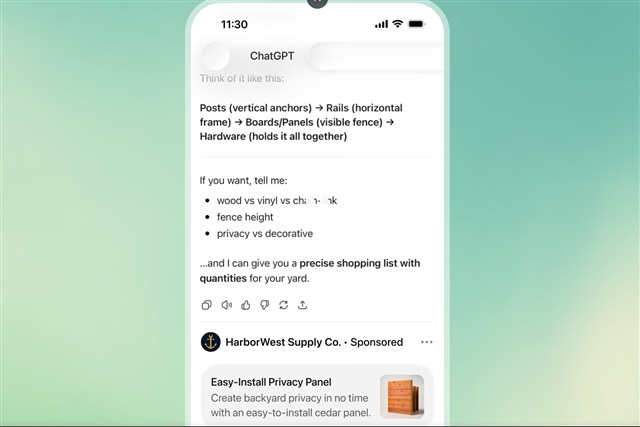
OpenAI is widening its ChatGPT advertising business beyond large brands, adding tools aimed at smaller marketers as it seeks to turn one of the world's most widely used AI products into a more measurable ad platform.
The company is expanding from early campaigns with major advertisers such as Adobe, Ford, and Target into offerings for smaller companies, including local businesses such as car washes and dry cleaners, The Information reported, citing people familiar with OpenAI's discussions with advertisers and ad-tech firms. The push brings OpenAI closer to Meta Platforms and Google, whose ad platforms already offer many of the buying and measurement tools OpenAI is now adding.
From brand ads to performance marketing
OpenAI is preparing ad formats designed to prompt users to take actions such as making a purchase, booking an appointment, or submitting a contact form. The formats are aimed at advertisers who care less about brand awareness and more about measurable outcomes.
The company has told some advertisers they will be able to test conversion-oriented ads, which would charge marketers only when campaigns deliver results. Advertisers testing those campaigns will need to install OpenAI's ad pixel, a piece of code that tracks what users do after clicking on an ad.
Pixels are widely used across digital advertising, but they are not foolproof because browsers and ad blockers can limit tracking. OpenAI is also encouraging advertisers to connect their internal systems with a recently launched application programming interface, allowing them to send back information about actions users take on their own websites.
OpenAI has publicly confirmed the broader product direction. The company said it recently launched Conversions API and pixel-based measurement to help advertisers understand what happens after a user engages with an ad, including purchases, leads, sign-ups, and other actions.
The company said advertisers receive aggregated performance insights and do not get access to individual conversations. It also said ChatGPT's answers will remain independent from ads and that conversations will stay private.
Self-service tools lower entry barriers
OpenAI is also making ChatGPT ads easier to buy. The company said advertisers can now create campaigns through partners or through a new beta self-serve Ads Manager.
The portal allows businesses to register as advertisers, add payment information, set budgets and bids, upload ads, manage campaigns, and view performance. OpenAI said the tool is intended for companies of all sizes, from startups and SMBs to global brands.
That marks a shift from the early phase of ChatGPT ads, which relied heavily on direct sales and large agencies. OpenAI initially required a minimum commitment of US$200,000 for an early trial when it launched ads in February, but it has since begun rolling out a self-service portal that small and medium-sized businesses can use without minimum spending, agency executives told The Information.
OpenAI is also adding cost-per-click bidding after initially selling ads on a CPM, or cost-per-thousand-impressions, basis. CPC bidding allows advertisers to align spending more closely with user actions after an ad is shown, while OpenAI continues to support CPM buying.
Partners fill gaps as OpenAI builds
OpenAI has been expanding access through agency and technology partners as it builds out its own advertising tools. The company said it has been working with agency partners, including Dentsu, Omnicom, Publicis, and WPP, as well as technology partners such as Adobe, Criteo, Kargo, Pacvue, and StackAdapt.
The partner strategy gives OpenAI a faster path to advertiser demand while its own ad platform is still developing. Criteo and StackAdapt are among the outside firms helping clients buy ChatGPT ads, while also offering capabilities OpenAI still lacks, including technology for matching ads with relevant users.
Some ad buyers are already shifting toward buying ChatGPT ads through outside firms rather than directly from OpenAI because of those added capabilities. Financial details of the partnerships, including whether OpenAI is paying for distribution or what fees intermediaries may charge advertisers, could not be learned.
OpenAI has also been meeting with outside ad-tech firms to discuss ways to help advertisers better understand the context in which their ads appear inside ChatGPT conversations. That could help marketers become more comfortable testing a new ad environment built around user prompts rather than traditional search queries or social feeds.
The effort is being led by executives with deep experience in digital advertising. Dave Dugan, who joined OpenAI in late March to lead ad sales, has been involved in those meetings, along with Benji Shomair, Vijaye Raji, and Asad Awan. All previously spent significant time at Meta.
Revenue ambitions face early tests
Advertising is becoming a central part of OpenAI's effort to generate revenue from ChatGPT's large free user base. The company has told investors it expects ad revenue to reach US$2.4 billion this year, roughly quadruple in 2027, and hit US$102 billion by 2030, representing more than 35% of overall revenue.
Faster ad growth could strengthen OpenAI's appeal to investors as the company works with banks to prepare for a possible initial public offering as early as this year. Still, it remains unclear how quickly OpenAI can scale a business that competes with mature platforms built over many years by Meta and Google.
The company is also exploring ways to serve online merchants by linking product feeds with ad campaigns. Such a system could use merchant catalogs to show ads that are more relevant to ChatGPT conversations, though a timeline for launch remains unclear.
Product-feed ads could be difficult to execute. They would likely require standardized data such as prices, availability, and product descriptions, and OpenAI's earlier in-chat shopping effort was slowed in part by messy merchant data before the company stopped work on it in March.
For now, advertisers are still treating ChatGPT ads largely as an experiment rather than shifting dedicated budgets away from other platforms. Early campaigns have shown strong click rates, but new ad networks often see performance taper as ad volume rises and the novelty for users fades.
Article edited by Jack Wu