
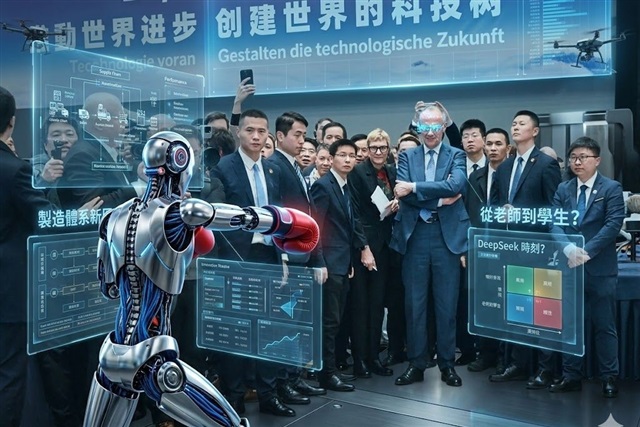
During German Chancellor Friedrich Merz's visit to China, the most closely watched stop was Hangzhou-based Unitree Robotics. Footage showed Merz standing with arms crossed, nodding and reacting with visible surprise to a humanoid robot's martial arts demonstration.
This was more than a routine corporate visit. It reflected a shift in the global manufacturing landscape. When the leader of a traditional industrial powerhouse visits a 10-year-old Chinese robotics start-up to observe and learn, the signal is unmistakable.
Germany's Industry 4.0 concerns
Germany has long been synonymous with industrial automation, leveraging precision manufacturing, sensors, and industrial control to secure its position in global supply chains. Yet Merz's remarks after returning home revealed concern over Germany's competitive position.
He questioned domestic emphasis on work-life balance and proposals such as a four-day workweek, arguing they could weaken industrial momentum. He admitted that "we are not as good as we think we are" and warned of being overtaken by China.
This contrasts with what he observed in China: a high-intensity industrial environment often described as a nine-to-nine, six-days-a-week work culture. Merz saw not only robotics hardware, but also how China integrates AI and hardware to move quickly from research to commercial deployment.

German Chancellor Friedrich Merz. Credit: Global Times
China's robotics density and industrial speed
According to China's Ministry of Industry and Information Technology, by 2025, the country had more than 140 humanoid robotics companies and over 330 new robot products launched in a single year. This reflects not only scale but supply chain density. From reducers and servo drives to AI chips and large model platforms, upstream and downstream segments are forming a concentrated cluster.
China also has abundant real-world deployment scenarios, from EV production lines and smart logistics warehouses to precision assembly facilities. This scenario-driven model enables repeated testing and optimisation in live environments. The speed of iteration has drawn attention from European industry.
Driven by companies such as Unitree, humanoid robots have moved beyond laboratories into pilot testing on automotive component lines. Unitree founder and CEO Wang Xingxing has acknowledged that long-term task planning and system integration require improvement. Chinese companies are accelerating proof-of-concept validation in live production settings.
Humanoid robotics requires deep software-hardware integration and rapid AI iteration. Chinese companies show higher tolerance for trial and error and faster development cycles. Germany's traditional industrial robotics model prioritises stability and precision.
When standards are still evolving, those who complete commercial validation from zero to one more quickly are better positioned to shape industry leadership.
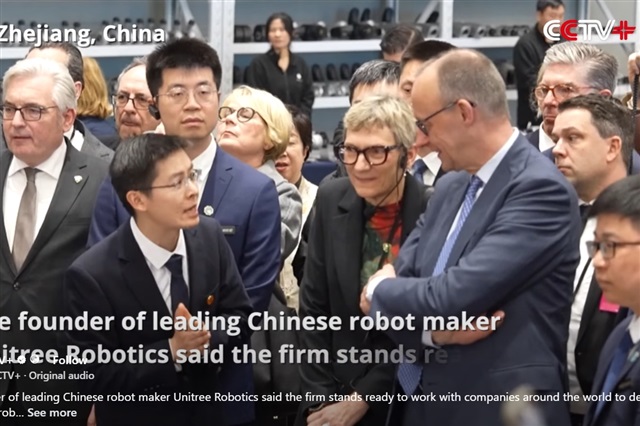
Unitree founder Wang Xingxing (left) and Friedrich Merz. Credit: CCTV
Is China's robotics industry nearing a "DeepSeek moment"?
If the rise of AI models marked a "DeepSeek moment," the question is whether China's robotics sector is nearing a similar inflection point.
From policy formulation and standards development, including the "Humanoid Robot and Embodied Intelligence Standard System," to capital investment and scenario deployment, China's approach has been rapid. In an era of fast AI iteration, decision-making speed and industrial flexibility are new competitive thresholds.
China's robotics industry still faces constraints. AI model capability remains limited. Some core components rely on imports. Application scenarios are fragmented, and cost pressures persist. Large-scale international deployment will require further progress.
A new phase of robotics competition
For Germany, the issue is not only being overtaken, but also how to reposition within a shifting manufacturing landscape. Germany retains strengths in precision machinery, industrial standards and sensor technology. China's advantages lie in AI computing power, data scale, and market speed.
The next phase of competition will be shaped not only by technology, but by industrial tempo and integration efficiency. For Taiwan's supply chain, the shift warrants close attention. Whether China's humanoid robotics cluster evolves into a global "DeepSeek moment" will depend on technological maturity and market validation.
Article translated by Levi Li and edited by Jack Wu