The rapid advancement of space technology has led to a growing range of applications, including satellites and launch vehicles, attracting significant cross-sector investment worldwide. As space becomes an increasingly strategic industry, governments are accelerating deployment efforts to secure technological leadership and industrial competitiveness.
Against this backdrop, Taiwan's Industrial Technology Research Institute (ITRI), through its Commercialization and Industry Service Center, partnered with the Department of Space Science and Engineering (DSSE) and the Center for Astronautical Physics and Engineering (CAPE) at National Central University (NCU) to organize the "Taiwan-Japan Space Education Exchange Delegation." The initiative targets students and early-career professionals interested in space technology, offering structured coursework and site visits to provide first-hand insight into global space industry developments and cultivate internationally minded talent for Taiwan's emerging space sector.
The program centers on international industry-academia collaboration. ITRI provided industry trend analysis and facilitated R&D resource connections, while NCU designed and delivered academic training. The itinerary included visits to the Japan Aerospace Exploration Agency (JAXA), space technology enterprises, and major research facilities in Japan, enabling participants to bridge theoretical learning with real-world industrial operations and international cooperation models.
Pre-departure workshop builds foundation for overseas engagement
A pre-departure workshop was held at NCU on January 17 to equip participants with essential technical knowledge and industry context prior to departure. The curriculum covered space science fundamentals, satellite systems engineering, industry trends, and applied operations, providing a concentrated introduction to core space-sector competencies.
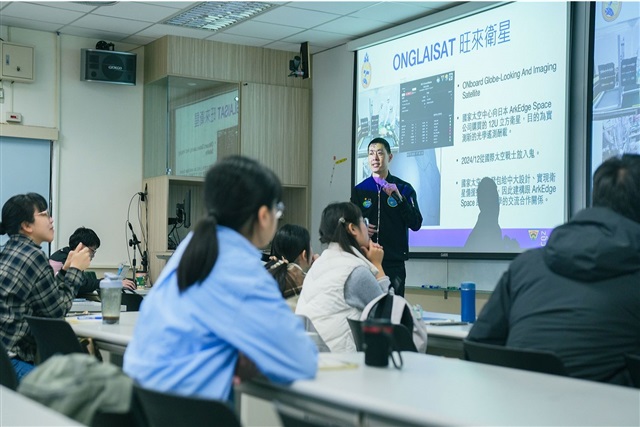
The session highlighted NCU's research capabilities and emphasized the interdisciplinary integration of physics, mathematics, electronics, data analytics, and engineering practice. In the "Introduction to Space Environment and Satellite Systems Engineering" course, participants examined satellite design under extreme space conditions, as well as mission planning, testing, and operational workflows, laying the groundwork for subsequent field visits.
Hands-on satellite training was also conducted. Led by SIGHT Space, participants assembled satellite structures, integrated sensors, and collected real-time data using the SMEK Educational Satellite Platform, translating theoretical engineering concepts into practical experience.
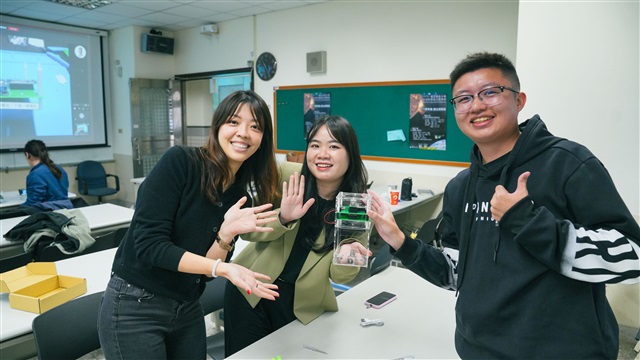
ITRI and NCU host a pre-departure workshop featuring hands-on satellite training by SIGHT Space. Credit: ITRI
Visit to JAXA Tsukuba Space Center integrates theory and practice
The program began in Tsukuba, Japan, with an astronaut workshop led by experts "Japan Manned Space Systems Corporation(JAMSS)" experienced in human spaceflight missions. The curriculum incorporated NASA's Artemis Program, outlining the architecture and technical challenges of renewed lunar exploration and offering a mission-level perspective on current space strategies.
In addition to lectures, the workshop featured a lunar exploration simulation exercise replicating mission execution scenarios. Participants made decisions under resource constraints and time pressure, gaining insight into task allocation, risk management, and team coordination. The module was adapted from elements of Japan's astronaut selection process, emphasizing analytical thinking and adaptability.
Through exchanges with instructors and industry professionals, participants explored diverse career paths spanning engineering development, mission planning, and international collaboration. The workshop translated space exploration from an abstract concept into structured industrial processes.
On the second day, participants toured the JAXA Tsukuba Space Center, a key hub of Japan's space activities. Established in 1972, the center oversees satellite development, mission control, astronaut training, and foundational research.
The visit included major testing infrastructure such as a 13-meter-diameter environmental chamber, vibration and radio-frequency testing systems, and vacuum simulation facilities, providing direct insight into pre-launch verification procedures.
Participants also observed operations at the mission control center for the Kibo module of the International Space Station, where they learned how ground teams coordinate with astronauts in real time and conduct remote microgravity experiments. The visit underscored the scale of system integration required for national-level space missions.
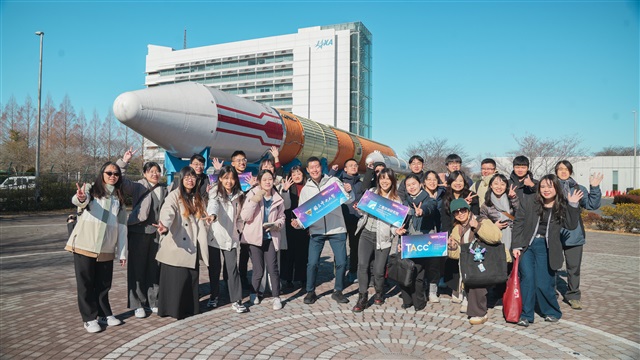
Participants visit the JAXA Tsukuba Space Center during the Japan study program. Credit: ITRI
Industry visits to ArkEdge Space and ispace provide market insight
Japan's private sector has become an increasingly influential force in space development. As part of the program, participants visited ArkEdge Space, a company specializing in small satellite development. ArkEdge is building an integrated ecosystem covering satellite design, production, ground station operations, and key component development, aiming to lower entry barriers through commercialization.
Its 6U CubeSats support missions ranging from Earth observation and communications to navigation and lunar applications. During the visit, ArkEdge shared insights into modular design and shortened development cycles, illustrating operational approaches adopted by emerging space enterprises.
ArkEdge has collaborated with the University of Tokyo, Taiwan Space Agency (TASA), and NCU on the ONGLAISAT mission, contributing to the technological foundation of Taiwan's ultra-high-resolution optical remote sensing capabilities. The project represents a concrete example of Taiwan-Japan industry-academia cooperation.
Participants also visited ispace, a company focused on commercial lunar development with the goal of extending human presence beyond Earth. ispace invests in lunar transportation, exploration, and resource utilization technologies, reflecting broader commercialization trends in deep-space missions.
The company's core technology centers on its independently developed lunar lander. The team outlined mission architecture and technical challenges spanning launch, transit, and lunar orbit insertion. Hakuto-R Mission 2 carried a Deep Space Radiation Probe developed by NCU, marking the first time a Taiwanese research payload traveled beyond low Earth orbit and representing a milestone in bilateral cooperation.
Participants said the visit reshaped their perception of the Moon as not only an exploration objective but also a potential pillar of the future space economy. Discussions highlighted pathways for translating academic research into commercial missions, reinforcing the role of sustained industry-academia collaboration.
The program also included a visit to Space Travelium TeNQ, a space-themed experiential facility integrating technology, art, and education. Through interactive exhibits and virtual reality, participants explored spaceflight concepts from a different perspective. In the VR experience "SORAVEL LINE," they simulated a lunar journey from Earth departure to lunar surface landing, deepening their understanding of microgravity environments.
Participants affirm value of structured international engagement
The program received strong feedback from participants. Engagement levels across online briefings, pre-departure training, and on-site visits averaged 4.4 out of 5, reflecting sustained participation throughout the program.
Survey results indicated that the astronaut workshop, satellite hands-on training, and company visits were the most impactful components. Participants reported broader technical perspectives and clearer direction in academic planning and career development, with several expressing increased interest in space engineering and related interdisciplinary fields.
As competition in the global space sector intensifies, talent development and international collaboration remain central to long-term industrial positioning. The Taiwan-Japan Space Education Exchange Delegation represents a structured effort to strengthen Taiwan's space capabilities through deeper bilateral engagement and practical exposure.