

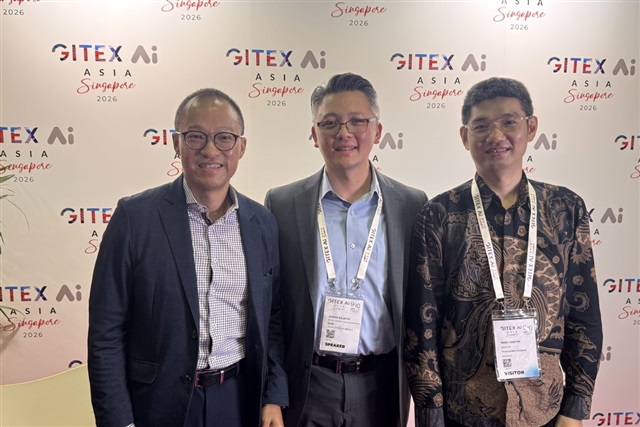
As generative AI demand shifts from centralized cloud training to edge inference, Nokia and AI chip startup Blaize have expanded their partnership in Singapore, unveiling a full-stack solution for hybrid heterogeneous computing at GITEX AI Asia.
In an interview with DIGITIMES, the companies said the integration of Blaize's graphics streaming processor (GSP) with Nokia's optical transport and data center interconnect (DCI) services is designed to address two key constraints in edge AI deployment: power efficiency and network bottlenecks.
Joseph Sulistyo, Senior vice president of global marketing at Blaize, said AI workloads are rapidly shifting from centralized training to distributed inference, with the inference market expected to be ten times larger than training. Edge environments, however, are highly sensitive to power consumption. Blaize's GSP architecture is purpose-built for inference, delivering roughly 60-70% lower power usage than competing solutions.
"Our architecture supports simultaneous parallel processing, allowing flexible deployment across edge endpoints—such as drones, smart cameras, and retail edge systems — and centralized data centers," Sulistyo said.
Within this hybrid framework, Nokia provides end-to-end connectivity spanning devices, edge nodes, and core data centers. Dion Leung, Nokia's head of AI and cloud for Asia-Pacific, said the company's solution offers terabit-level optical transport capacity alongside quantum-safe security capabilities. The partnership is anchored by Singapore's Network Innovation Lab, which serves as a validation platform for the joint solution.
Sulistyo and Leung said Singapore's engineering talent and innovation ecosystem make it an ideal base for developing and scaling the collaboration. They plan to showcase further deployment progress across the Asia-Pacific region at major international events, including Computex.
Sulistyo added that working with Nokia enables validation in real-world, large-scale network environments, shortening enterprise R&D cycles. "What we offer is not lab data, but telecom-grade, commercially viable solutions," he said.
Article translated by Levi Li and edited by Jack Wu