When the avocado has two hours left, the AI takes over.
Picture a busy Subway franchise on a Tuesday afternoon. A batch of fresh avocados was pulled from the refrigerator six hours ago. In an hour, they'll be unsellable — blackened and written off. In the old world, the store manager hovers near the counter, reminding part-time staff to push the avocado sub. The staff is already drowning in the lunch rush. The avocados go to waste.
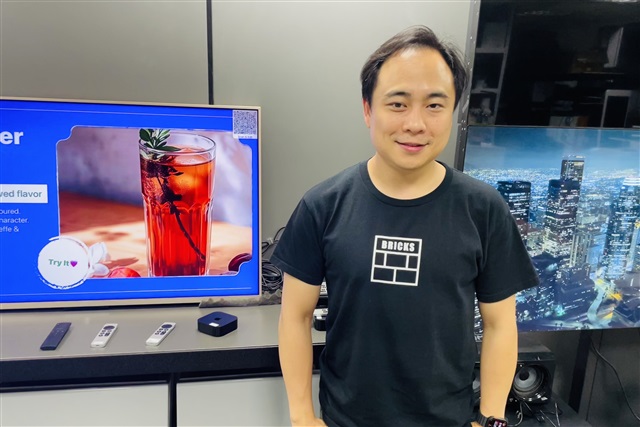
Now picture the same store with a small piece of hardware running quietly in the background. The moment the system detects less than two hours of shelf life remaining, the in-store digital menu board switches automatically: "Avocado Specials — Today Only." Competing items disappear, marked as sold out. No manager intervention. No reminder. No waste.
The same system can lower the security shutter, adjust the air conditioning, or trigger a customer notification — all without a human issuing a single command.
This is what BRICKS does. And according to founder Pepper Yen, the avocado is just the beginning.
Think bigger than an app
BRICKS is a Taipei-based startup that most people initially misread. When they hear "digital signage" or "AI-powered menu boards," they assume it's a software application company. Pepper corrects them immediately.
"We're not building an app. We're building an operating system."
The distinction matters. An app solves one problem. An operating system defines the environment in which any problem can be solved — by anyone, for anything. Windows didn't make Microsoft by solving one use case; it built the infrastructure that let an entire industry run on top of it.
BRICKS is attempting something analogous for a world where AI agents — not humans — are the primary users of software. Their platform, the Agentic OS, sits at the intersection of on-device AI inference, hardware control, and physical-world actuation. Its end user is not a person; it's an agent — making autonomous decisions in real environments and needing a reliable execution layer to act on them.
The chip is ready — the software is not
Qualcomm, MediaTek, and other chip companies are racing to ship edge AI silicon with Neural Processing Units capable of running small language models entirely on-device. The vision is compelling: private, low-latency AI running at the point of action.
But there's a gap between the silicon and usable intelligence.
Open-source AI models are evolving faster than any chip vendor's official SDK can track. A model released Monday might not have official NPU support for months, leaving the system integrators and software vendors who build on this hardware stranded — powerful chips, no clean path to the latest models.
"Our job," Pepper says, "is to make sure that whatever AI model was released yesterday can run on our partners' hardware tomorrow."
BRICKS acts as the firmware-to-software bridge — abstracting NPU driver complexity and providing a stable runtime that lets developers focus on what they want to build, not on making the chip cooperate. For hardware OEMs, this compresses time-to-market for AI-enabled features from months to days.
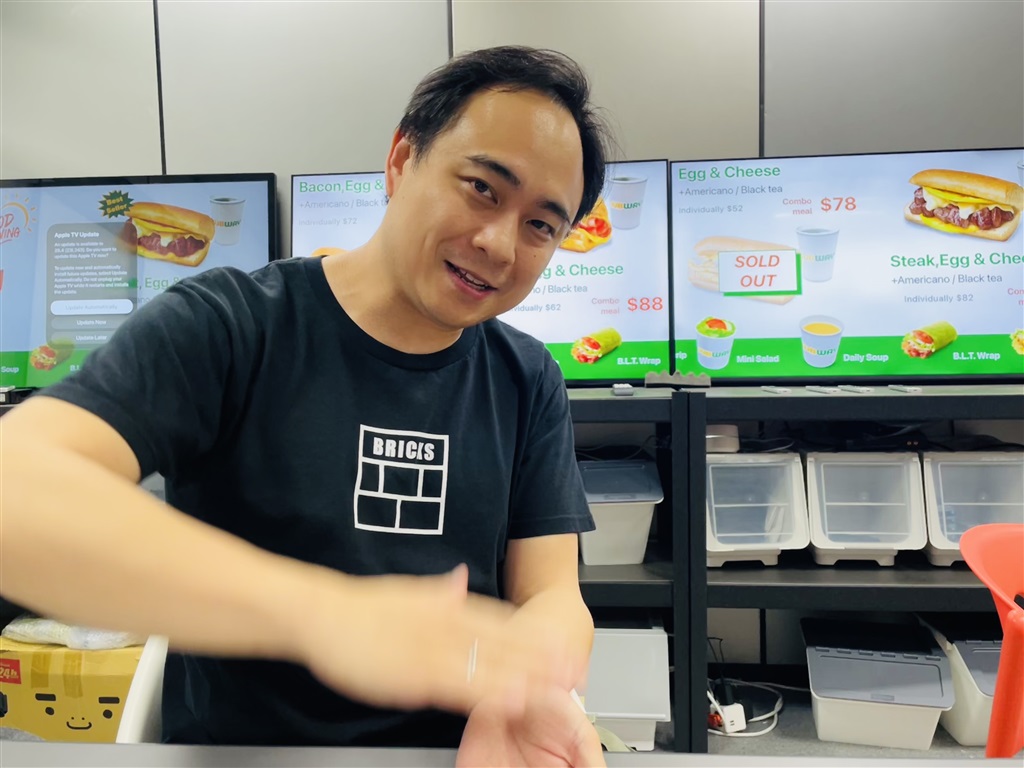
Credit: Digitimes
From weddings to the edge
BRICKS did not start as an infrastructure play. It started as a wedding game.
In late 2019, Pepper was running MyBigDay, an interactive entertainment platform for wedding receptions — guests playing live games through LINE, synced to a large display at the venue. A five-person team was generating over NT$3 million in monthly revenue. Then COVID-19 arrived, and every wedding in Taiwan was cancelled overnight. Revenue went to zero.
"We had to figure out what we actually had," Pepper recalls.
What they had was screen control technology. They took that kernel and knocked on doors across industries. Food and beverage responded strongest — restaurant chains were dealing with chronic labor shortages and menus that changed by the hour. BRICKS launched a sub-brand called Dongdongban targeting the F&B sector, and today serves over 300 restaurant brands across Taiwan.
The deeper pivot came from inside the team. BRICKS' CTO is a recognized contributor to llama.cpp and whisper.cpp — the open-source frameworks that made running large language models on edge hardware practical at scale. As generative AI exploded, BRICKS found itself holding an unusual combination: real hardware relationships, a functioning commercial product, and an engineer who understood model optimization at a level most AI startups do not.
The combination — edge AI inference, physical control infrastructure, and a secure execution environment — pointed toward something neither purely software nor purely hardware. The Agentic OS came into focus.
Cracking the hardware ecosystem
Penetrating a hardware ecosystem built on decades-long OEM relationships requires more than good technology. For BRICKS, the entry point was Qualcomm's Innovation Tech Competition in Taiwan. Selection brought access to Qualcomm's latest NPU chips and SDK, which BRICKS used to build live demos that attracted Advantech and Castles Technology and led to direct introductions to system integrators across the region.
With a Qualcomm track record established, MediaTek initiated its own partnership. BRICKS now provides the Reference Design for MediaTek-ecosystem hardware manufacturers, including CAYIN Technology — the baseline software stack that ships with devices, so developers inherit a working AI runtime rather than building one from scratch. Being the Reference Design means your software is the default. Device volumes become your distribution.
The business model has evolved in step. Starting with project-based development, BRICKS moved to SaaS subscriptions for F&B, and now royalty licensing as hardware partnerships deepen. Taiwan's largest revenue contributor is dudu, a major POS hardware manufacturer whose consumer-facing terminals run BRICKS technology under a white-label arrangement. Internationally, brands including CoCo Fresh Tea & Juice have extended the platform into over a dozen countries through pure cloud deployment — store operators plug in an Apple TV, and the system is live.
The largest partnership currently in development is with Navori Labs, the world's biggest digital signage CMS vendor with approximately 2 million commercial display endpoints globally. BRICKS is working with Navori on next-generation OS capabilities — a collaboration that, if it matures, gives BRICKS a path into one of the largest installed bases of commercial display hardware on the planet, without building a direct sales force in every market.
US$3M seed, and why it has to be Silicon Valley
BRICKS is raising a US$3 million seed round. The team is 10 people, split between Taiwan and the US, fully remote. The primary cost is the kind of engineers who can work at the intersection of AI model optimization, NPU drivers, and safety-critical execution — a profile that is rare and expensive everywhere.
Taiwan's VC ecosystem is not structured for this. "VCs here want equity and a path to break-even in two or three years," Pepper says. "For infrastructure, that timeline doesn't reflect how value compounds." The market also lacks stage-specific investor specialization — seed investors frequently apply Series A-level diligence frameworks, creating a mismatch that disadvantages deep tech startups needing patient early capital.
Silicon Valley understands platform plays; it understands that the highest-value position in a technology stack is often the one furthest from the end user. And it uses SAFE instruments — allowing BRICKS to raise at a stage-appropriate valuation without the friction of a priced round. Pepper plans to spend three to four months in the Bay Area, using Plug and Play's network as the foundation for both investor and enterprise partner development.
Why he'll always be Pepper
People assume "Pepper" is a joke about his surname — 嚴 (Yen) sounds close enough to "salt" in Chinese that "Pepper Salt" becomes an obvious nickname.
The real story is different. Pepper spent part of his early childhood in the US, and by age five, had become so attached to Dr. Pepper — the soft drink — that he had stopped responding to his own name. His mother would call him. Nothing. Someone would say, "Dr. Pepper," and he would run across the room.
He moved back to Taiwan at five. The name stayed.
There is no grand lesson to extract from this. It is just a true thing about who he is: when something genuinely has his attention, he moves toward it without hesitation. Everything else can wait.
Right now, that thing is building the Agentic OS for the physical world — the execution layer that lets AI agents stop thinking and start acting.
Article edited by Jerry Chen