
In 2011, China will enter its 12th Five-Year Plan period (2011-2015). The development goals, directions and industry strategies for the entire plan were set in October 2010, and will be of critical importance for China's development over the next five to ten years. This report looks at the core directions for development in the 12th Five-Year Plan.
The 12th Five-Year Plan makes it clear that China, which overtook Japan in 2010 to become the world's number two economy, has now turned its attention from the pursuit of national strength to increasing its people's prosperity. It places far greater emphasis on internal markets and domestic demand than ever before, and includes industrial structures that emphasize added value. The 12th Five-Year Plan also sets out seven major new strategic industries, for which investment is projected to reach CNY10 trillion over the next five years; the sheer scale of the commercial opportunities created needs no further explanation. However, China has typically left no stone unturned in its efforts to foster domestic enterprises, and the 12th Five-Year Plan is no exception in this regard, as the plans for the seven new strategic industries will also serve to significantly bolster the position of homegrown businesses.
China's 12th Five-Year Plan reorients China's industry towards a number of sectors that are still fairly new even in global terms. It also adds services and applications, demonstrating China's dissatisfaction with its previous status as a comparatively backward nation in technological terms, as well as its determination to leverage the country's massive domestic market and participate in the creation of new business models and standards for such industries in their formative stages. In the future, China is likely to make giant leaps forward in growth for sectors as diverse as new communications applications and renewable energy, as well as gaining a firm grasp of core technologies and standards. This report clearly explains China's intentions in all these areas.
Chart 1: Key directions for adjustments to China's economic structure under the 12th Five Year Plan
Chart 2: Rates of urbanization in major global regions and countries
Chart 3: Orientation of development for China's four main regional blocks
Chart 4: China's "two horizontal and three vertical lines" arrangement of cities
Table 2: China's 5 main classes of city cluster and the scope of their development
Chart 6: Four quantitative criteria for adjusting China's industrial structure
Chart 7: Key points for adjusting China's investment structure
Focus and target of seven major emerging strategic industries
General strategy for core industries under the 12th Five-Year Plan
Chart 9: Goals and competitiveness of China's strategic industries
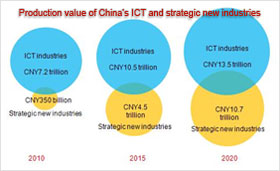
Chart 10: Production value of China's ICT and strategic new industries
Chart 13: Key development of next-generation ICT industries in China's 12th Five Year Plan
Chart 14: Achievements of ICT industries in China's 11th Five Year Plan
Chart 15: Development goals for next-generation ICT industries in China's 12th Five Year Plan
Chart 16: Development goals for next-generation biotech industries in China's 12th Five Year Plan
Chart 17: Internet users in China and penetration rates, 2006-2010 (k users)
Chart 19: Customers of major China Telecoms, by service, 2006-2010 (k users)
Chart 20: 3G users in China by technology, Dec 09-Sep10 (k users)
Chart 21: Connection between next generation IT technology and emerging industries
Chart 22: Role of network players in emerging IT industries in China
Industrial transformation and application innovation via next-generation netcom construction
Chart 24: Key focus for China's information industries through 2013
Outlook of China's Telecom Industry Under the 12th five-year plan
Chart 25: Communication development aspirations in China's 12th Five-year plan
Development of next generation TD-LTE wireless mobile communications
Table 3: TD-LTE R&D subsidy schemes launched by the China government
Chart 27: Frequency spectrum planning for TD-SCDMA and TD-LTE in China
Position and evolution of triple-network integration compared with preceding five-year plans
Chart 30: Triple-network integration in previous five-year plans
Chart 31: Timetable for development of triple network integration in China
Chart 32: Select cities for triple network integration trial implementation
Table 4: Triple network integration trial implementation plans for selected cities
Commercial prospects and affects of triple network integration in China's 12th Five Year Plan
Table 5: Formation of IoT industry alliances in China's key regions
Chart 35: 2015 IoT development output value targets set by various regions
Chart 36: Main IoT applications for the World Expo 2010 Shanghai
Chart 37: Four main industry development directions for IoT in Shandong
Chart 38: China's position in the global lighting industry, 2009-2010
Table 7: China government solid state lighting roadmap, 2000-2015
Balanced development of solid-state lighting between economic growth and energy saving
Chart 41: China imports of oil and coal, as share of country's energy consumption
Chart 42: China government goals for economy and environment by 2020
Chart 43: Non-fossil fuel energy source development targets in China's 12th Fifth-Year Plan (GW)
Table 11: Nuclear power during the 12th Five Year Plan period
Chart 46: Planned installed capacity for China's 13 major hydroelectric centers (GWp)
Chart 48: Cities selected for China's "Ten Cities, One Thousand Vehicles" electric vehicle plan