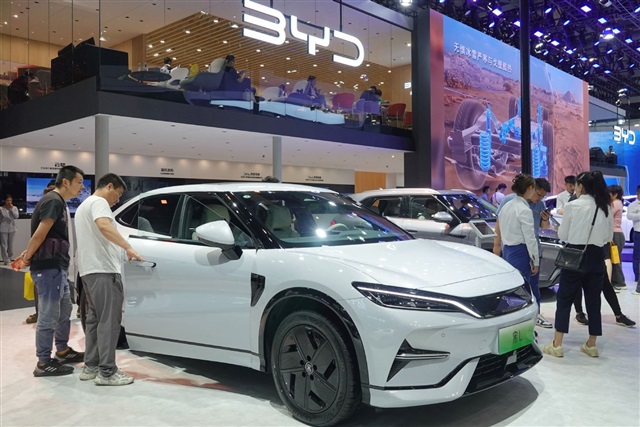
Chinese automaker BYD is reportedly exploring options to expand its presence in India, including local assembly, as demand for its electric vehicles (EVs) continues to rise, according to people familiar with the matter. The company is evaluating semi-knocked-down (SKD) assembly and working to obtain local safety and regulatory approvals for additional models, according to Bloomberg, in order to navigate import quotas.
India previously rejected BYD's proposal to build a full-scale assembly plant, but assembling partially built components could offer a faster, more cost-effective route to increase supply. Any move toward local production would follow visits by senior BYD executives, the sources said.
Strong demand prompts strategy shift
BYD's surge in India has prompted a reassessment of its market strategy. Dealers reportedly hold hundreds of pending bookings, highlighting the gap between demand and supply. In contrast, Tesla Inc., which also operates in the Indian market, has offered discounts on certain models to boost sales, underscoring differences in market positioning.
Since entering India's passenger EV segment in 2021, BYD has launched the Atto 3 compact SUV, the eMax7 multipurpose vehicle, the Seal sedan, and the Sealion 7 SUV. In 2025, the company's India sales reached approximately 5,500 units, an 88% increase from the previous year. Most of these sales exceeded the country's import quota of 2,500 units per fully built model, with import duties of up to 110% on fully built cars. Using SKD assembly could reduce tariffs to around 30–70%, potentially improving affordability.
Pricing strategies drive market share
BYD's Atto 3, priced at roughly INR2.5 million (US$27,255) including tariffs, positions the car at the premium end of India's mass-market EV segment while remaining below Tesla's pricing. The Sealion 7, which sold 2,200 units in 2025, is priced between INR4.9 million and INR5.5 million, undercutting Tesla's Model Y, which starts at INR6 million. These pricing strategies have enabled BYD to capture market share despite high import duties.
Regulatory hurdles shape expansion plans
The company faces regulatory hurdles that have limited large-scale investment. A proposed US$1 billion joint venture with Indian partner Megha to build a 100,000-unit EV plant was rejected in 2023 on national security grounds. Additionally, India's stricter foreign direct investment policies and visa restrictions for Chinese executives have complicated operations. Tariff barriers for fully imported vehicles also limit BYD's pricing flexibility.
To navigate these challenges, BYD is reportedly considering partnerships with local firms and SKD assembly, following models used by other foreign automakers in India. Analysts say the company is focusing on gradually increasing its local presence while complying with regulatory constraints. Diversifying outside China has become more important for BYD amid slower domestic growth, reduced EV subsidies, and intensifying competition, with the company targeting a nearly 25% increase in overseas deliveries this year.
Article edited by Jerry Chen