

CONNECT WITH US

Techman's product shift and semiconductor focus could sustain growth despite macro uncertainty

Aaron Lee, Taipei 0

Credit: DIGITIMES

Techman Robot plans to release a dual-arm robot and deploy an upgraded humanoid model at customer sites in the second half of 2026, moves the company says will broaden its addressable market and deepen ties to semiconductor customers.

The company reported revenue of NT$1.822 billion (approx. US$56.8 million) for 2025, a 23% increase year-over-year, with gross margin steady at 51%. Operating profit rose 413% to NT$111 million, and earnings per share increased 40% to NT$1.46.

Management attributes the performance to the company's native vision systems and AI capabilities, which it says improved inspection competitiveness and helped capture growth in semiconductor-related demand across Taiwan and mainland China.

Product roadmap aims at practical factory use

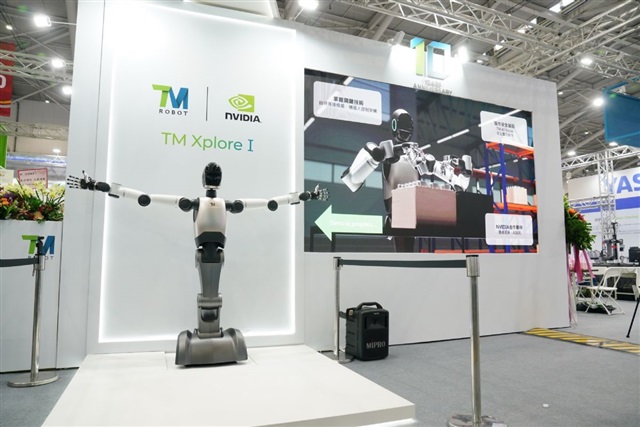
Techman is moving beyond its original focus on single-arm robots differentiated by payload and reach, and will introduce dual-arm models in 2026. The company also plans to roll out an upgraded humanoid robot, Xplore I, in the second half of 2026, with initial units being deployed at customer sites for training. Management emphasized that practical manufacturing requirements are driving design choices for humanoid platforms; wheeled configurations are preferred over bipedal locomotion where stability and utility matter more.

Although Chinese competitors have demonstrated advanced bipedal balance in public performances, Techman prioritizes factory training applications and sees wheeled humanoid designs as more immediately useful. The company is nonetheless continuing development on bipedal humanoids alongside wheeled models.

Expanding automation services and semiconductor dominance

Beyond robotic arms, Techman's full-factory automation offerings contributed to significant revenue expansion, rising from NT$66 million in 2024 to NT$280 million in 2025. The company expects further growth from this segment in 2026 and positions it as an additional operational driver.

Techman highlights an "absolute advantage" in the semiconductor robotic arm market in both Taiwan and China and notes that its inspection technologies are being applied across nearly all industries. The company contrasted its 2025 results with those of peers, noting that industry leader Universal Robots experienced a 20% revenue decline and South Korea's Doosan Robotics saw a 40% decline. Management expressed confidence in continued expansion into 2026 despite acknowledging uncertainties in the macroeconomic environment.

Recent collaborations include a demonstration of motion training technology using MOXI wearable motion capture devices at the GTC conference, in partnership with J-Mex, underscoring the company's emphasis on precision motion training as part of its broader automation and training solution set.

Article translated by Jingyue Hsiao and edited by Jack Wu