
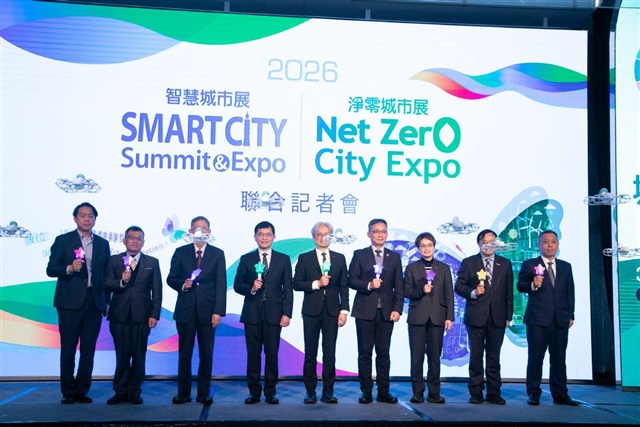
The Smart City Summit & Expo and Net Zero City Expo will open next week across Taipei and Kaohsiung, maintaining a dual-city format for 2026 and expanding its focus from net zero and sustainable energy to AI-driven end-user applications.
Organizers from the Taipei Computer Association (TCA) said the event will highlight AI City solutions alongside traditional smart energy, transportation, and urban governance technologies. The expo will present a new premium "AI City" lineup, intelligent robot demonstrations, and virtual power plant use cases among more than 3,000 showcased solutions from over 700 domestic and international companies.
The TCA announced at a March 10, 2026, press briefing that the exhibits span urban governance, smart energy, intelligent transportation, and AI application services. The event aims to align industry innovation with government initiatives under the "AI New Generation Infrastructure" initiative, which promotes an "All-People Smart Living Circle." Organizers said the goal is to integrate AI into daily life, covering food, clothing, housing, transportation, education, and entertainment, to enhance convenience.
Taiwan's AI national team takes center stage
For the first time, the expo will host an "AI CITY Pavilion" anchored by Taiwan's AI national team, led by AsusTek Computer Inc. and Foxconn. The pavilion brings together 30 Taiwanese companies to integrate 60 AI solutions covering AI computing infrastructure, localized model optimization, trusted data, and cybersecurity platforms. Exhibits cover scenarios in transportation, security, healthcare, and urban governance, forming a chain from technical foundations to public service operations. The organizer described this as the world's first full-spectrum AI City solution tailored to "urban sovereignty AI" needs.
A dedicated zone titled "AI Robot drives new smart living future," planned with the Intelligent Robotics SIG and Tainan City Government, will present a range of robotics applications transitioning from industrial chains to urban deployments. The showcase will emphasize medical care, food service, logistics, warehousing, and inspection and disaster relief, with demonstrations of service robots, autonomous mobile robots, and inspection/firefighting robots combined with local field validation results. Companies participating include Asustek, Syscom, TECO Electric, Nexcom International, and Mirle Automation.
Virtual power plants take on grid stability
The expo will also highlight virtual power plants, or VPPs, as part of its sustainable energy content. Organizers described VPPs as systems that use information and communications technology to aggregate electricity from dispersed sources such as homes, institutions, or factories, and supply utilities or enterprises that require additional power. More than 10 companies, including Delta Electronics, Tatung Forever Energy, Allis Electric Co., and Ancillary Power, are reported to offer collaborative VPP and microgrid solutions for industrial zones, communities, campuses, and data centers. The TCA characterized this as Taiwan's first dedicated VPP application-scenario showcase, intended to stabilize the island's power grid through multi-vendor participation.
Startups and global cities flock in
The startup zone will feature over 250 global startups, attracting teams from Japan, Thailand, India, Hungary, and other markets. The Startup Association will participate for the first time, with stated aims of converting Taiwan's technology strengths into systematic exportable solutions and creating replicable international models.
International city delegations increased, with representatives from 53 countries and regions and 174 cities visiting Taiwan. Municipal participation rose 17% compared to 2025, driven mainly by Asian markets, with the top five sending countries listed as Thailand, Vietnam, Malaysia, India, and Indonesia. The organizer asserted that this level of international engagement further supports Taiwan's technology exports and overseas market expansion.
Article translated by Jingyue Hsiao and edited by Jerry Chen