Taiwan and the United States have rapidly advanced industrial technology cooperation across sectors, from drones to robotics, in recent years. The GeoAsia Foundation recently announced a strategic alliance with Curiosity Lab, an innovation park in Peachtree Corners, Georgia, to establish the Taiwan Robotics Hub in the US city. This initiative aims to leverage bilateral industry strengths to advance AI and robotics technologies and foster a robust Taiwan-US robotics ecosystem.
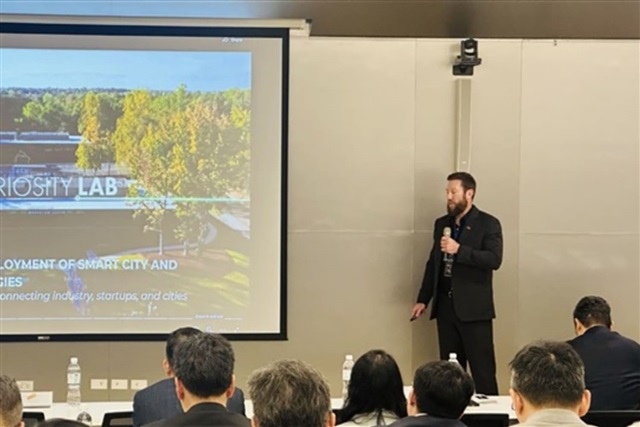
The Taichung-based GeoAsia Foundation detailed the collaboration at a forum on April 8. Seth Yurman, an adviser to Curiosity Lab and also deputy city manager of Peachtree Corners, traveled to Taiwan to personally present the lab's planning and features. His visit underscored the importance of this partnership.
Among the key attendees at the forum were Janee Pierre-Louis, commercial section chief at the American Institute in Taiwan (AIT); former National Development Council (NDC) minister Paul Liu; Nexcom chairman Clement Lin; and NexCobot general manager Jenny Shern. Senior executives from Foxconn (Hon Hai) and Delta Electronics were also present in a show of support.
Yurman described Curiosity Lab as a government-established smart city living laboratory spanning about 200 hectares in Peachtree Corners. It serves as an ideal testbed for smart city innovations, featuring 5G connectivity and public roads designated for autonomous vehicle testing. The site attracts major corporations and startups alike, including Nvidia, Intel, Cisco Systems, and Siemens. Current development priorities include drones, robots, intelligent transportation, and smart mobility solutions.
GeoAsia Foundation chairman C.Y. Huang emphasized that under the Trump 2.0 era, Taiwanese investment in the US has expanded well beyond semiconductors into a broad range of industries. He noted that Taiwan is not just about semiconductors, as it has diverse sectors, with robotics being one of them. He called this deepening Taiwan-US technological cooperation a significant milestone.
Huang added that the Taiwan Robotics Hub will bring together enterprises, startups, and university research units within Curiosity Lab to build an integrated robotics ecosystem by combining Taiwan and US resources. This will help Taiwanese companies make a strategic entry into the US market. Already confirmed tenants include Nexcom Group and its robotics-focused subsidiary NexCobot, along with medical startup Imedtac.
Shelton Chan, executive director of IPaT Asia-Pacific at the Georgia Institute of Technology, highlighted two advantages of Curiosity Lab for Taiwanese firms: low costs and its reputation as a living laboratory — a fully operational city where companies can demonstrate products directly to customers and integrate solutions with smart city infrastructure. Additionally, situated in the Atlanta metropolitan area, Peachtree Corners offers a favorable environment for small and medium-sized enterprises entering the US market. The region is also a key cluster for humanoid robots, drones, and unmanned vehicle systems development in the US.
Article translated by Rodney Chan and edited by Jerry Chen