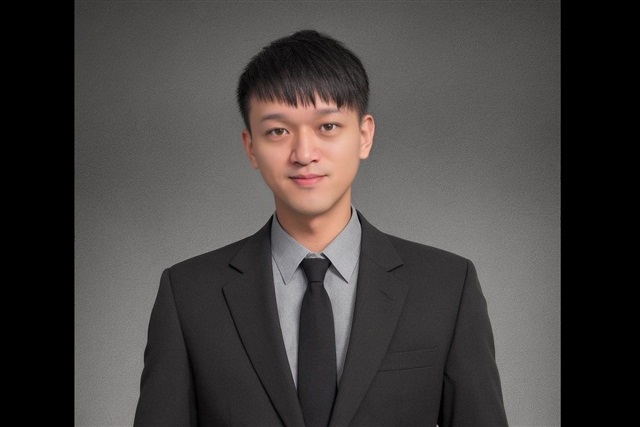
As global manufacturing accelerates its smart-factory transition, computer vision is taking on an increasingly critical role in industrial quality inspection. Canadian AI startup DaoAI, on the strength of its innovative AI vision technology, has secured partnerships with international heavyweights including Siemens and BASF. Co-founder and CTO Xiaochuan Chen explains how DaoAI uses "Feature Cognition Inspection" to solve the high false-call rates and time-consuming programming pain points of traditional Automated Optical Inspection (AOI), and reveals plans to actively pursue deeper partnerships with Taiwanese equipment makers and distributors during COMPUTEX 2026.
From Academic Research to Industrial Practice: Bringing AI to the Electronics Manufacturing Floor
DaoAI CTO Xiaochuan Chen has been working in AI and vision research in Canada since 2014 - right at the inflection point of deep learning. In 2017, he co-founded DaoAI in Vancouver alongside a partner with a track record of successful entrepreneurship, leading a top-tier AI vision team drawn from University of British and University of Waterloo and focused squarely on industrial automation.
Chen sees enormous potential for AI in manufacturing across both North American and Asian markets. DaoAI's technology not only lifts production yield but also protects enterprise data sovereignty through its on-premise data architecture. "We understand that in any digital transformation, the security and ownership of data is a core interest for manufacturers - and that's the foundation our technology is built on," Chen says.
Solving the Long Programming Cycles and High False-Call Rates of Traditional AOI
Traditional AOI algorithms running on PCBA (printed circuit board assembly) inspection lines are notorious for high false-call rates. Chen explains that conventional algorithms rely heavily on color matching or pixel-level comparison - when, for example, a resistor and the board substrate are both black, traditional algorithms struggle to tell them apart.
DaoAI's core technology is Feature Cognition Inspection. The model is pretrained on a dataset of more than one million images, abstracting what the AI sees into a specialized feature space. The advantages show up at two levels: 1. Multi-dimensional differentiation: the AI no longer compares colors - it precisely distinguishes whether a defect is present on a component within feature space. 2. Continuous learning: the system mirrors how humans learn. If the AI gets a call wrong on the first pass, the inspector's feedback is fed into its memory system, so the next time a similar component appears, the same mistake doesn't recur.
"We pretrain a PCBA-specific inspection model on real production-line data," Chen explains. "All the customer needs is a single 'reference board.' Without any CAD file or component library, the AI identifies the location of every component, automatically generates inspection regions, and automatically calculates thresholds. Programming can be done in seconds or minutes - the AI takes over the part of AOI that historically required the most human intervention."
This kind of fast programming is especially well-suited to high-mix, low-volume production. It dissolves the bottleneck that NPI (new product introduction) phases used to hit, where modeling was slow and dependent on dedicated programming engineers.
Solving the Compute-and-Sovereignty Trade-off Without Cloud Dependence
For data sovereignty and information security issues that customers care about deeply - DaoAI runs 100% on-premise. To deliver high performance within the limited compute budget of edge hardware, DaoAI takes a "pretraining + rapid fine-tuning" approach: customers run a pre-tuned, optimized specialty model locally while keeping their data fully secure.
Cross-Border Partnerships and the COMPUTEX Strategy: Complementing Taiwan's Supply Chain
DaoAI has already established deep partnerships with Siemens (electronics manufacturing and automation platform integration) and BASF (vision analysis applications in chemicals). Looking ahead, Chen is bullish on the Taiwan market and announced that DaoAI will participate in COMPUTEX for the first time this year.
DaoAI positions itself as a vision-AI application company, Chen says, and the trip to Taiwan has two strategic objectives: 1. Hardware integration: partner with local Taiwanese equipment manufacturers to combine DaoAI's AI software algorithms with Taiwan's high-quality hardware, delivering customized solutions. 2. Distribution expansion: identify professional distributors and service partners in Taiwan to get closer to local electronics manufacturing customers.
Beyond Surface Mount Technology line inspection, DaoAI is also strongly interested in semiconductor packaging and testing and is looking to co-develop new applications with Taiwanese probe and inspection equipment makers - pushing the boundaries of vision AI further still.