

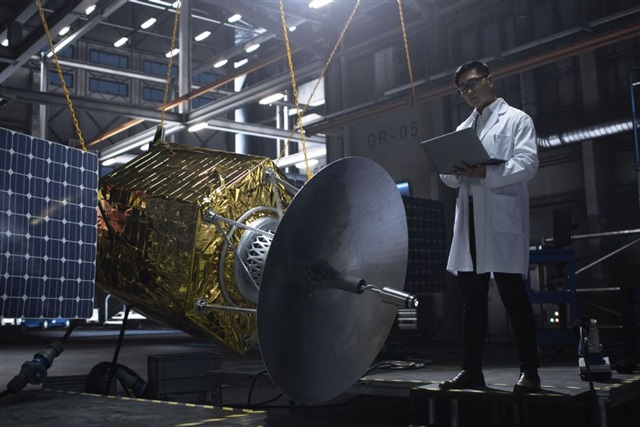
As global demand for AI computing power surges, conventional ground-based data centers are increasingly constrained by limits in energy supply and cooling capacity.
Against this backdrop, Beijing on the 27th unveiled an ambitious plan at a space data center development work meeting: to move large-scale AI computing into orbit and stake out what it describes as the next strategic high ground for advanced computation.
The initiative signals not only an expansion of computing frontiers but also the opening of a new chapter for the aerospace industry.
According to planning details presented at the meeting, Beijing intends to build and operate a centralized, gigawatt-class data center in a sun-synchronous orbit 700 to 800 kilometers above Earth.
The system would consist of three major components: space-based computing, relay communications, and ground control. The space segment envisions multiple orbital data centers, each with roughly 1 gigawatt of power capacity—enough to support clusters of servers on the scale of millions of cards—designed to handle data relays and in-orbit computation.
A three-phase roadmap for the next decade
The blueprint divides the project into three phases over roughly 10 years:
Phase I (2025–2027)
Focus on breakthroughs in key technologies such as power generation and thermal management in space. This stage will involve iterative test satellites and the deployment of a first-phase "computing constellation" with up to 200 kW of total power and 1,000 POPS of computing capacity, aiming to achieve "data in space, computation in space."
Phase II (2028–2030)
Develop technologies for on-orbit assembly and construction while reducing costs. A second-phase computing constellation is planned, targeting applications in which data remain on the ground but computation occurs in space—"ground data, space computation."
Phase III (2031–2035)
Move toward large-scale commercial deployment, including mass production of satellites, networked launches, and in-orbit docking to create a fully built-out orbital data center capable of supporting next-generation "space-based primary computation."
Why compute in space?
Space-based computing refers to placing data centers and computing payloads in orbit, where satellites perform processing through onboard hardware, relying on high-speed laser links for data transfer.
Experts say the appeal lies in two inherent advantages: energy and cooling.
In sun-synchronous orbit, satellites receive nearly continuous sunlight, allowing for effectively "endless" solar power without the massive battery systems required on Earth.
Elon Musk has predicted that within five years, AI computation in space could be cheaper than on the ground, citing both abundant solar power and the feasibility of radiation cooling. In the vacuum of space, heat can be dissipated simply through thermal radiation without complex liquid- or air-cooling systems—potentially simplifying hardware and cutting operational costs.
Tech giants and start-ups race to orbit
The concept has rapidly gained attention from global technology leaders.
CEO of Alphabet Sundar Pichai, and Amazon founder Jeff Bezos have each described visions for orbiting data centers. Google has floated a "Suncatcher" satellite proposal, aiming to launch a prototype equipped with custom TPUs as early as 2027.
Nvidia, through its start-up accelerator programs, is backing companies such as StarCloud, which is building an orbital AI computing platform. Another project, DeStarlink Genesis-1, a partnership between companies in Canada and Singapore, will test Nvidia chips in low-Earth orbit.
In China, multiple efforts are underway, including the "Three-Body Computing Constellation" led by the Zhejiang lab, and a plan by Beijing Rail Transit Chengguang Technology to deploy computing satellites in sun-synchronous orbit. Guoxing Aerospace Technology launched the world's first orbital computing constellation in 2025 after beginning its space computing plan in 2024, achieving 5 POPS of in-orbit computing power.
Still, formidable obstacles remain. Data transmission and radiation-hardened chip technology are among the most difficult. A single satellite may generate terabytes of data per day, but because of limited ground-station coverage and spectrum bottlenecks, less than 10 percent can typically be downlinked. Cooling large GPU clusters in space through radiation alone would require tens of thousands of square meters of deployable structures—far beyond today's spacecraft engineering limits.
Beijing treats space computing as a strategic frontier
Beijing Municipal Science and Technology Commission said space data centers are emerging at the intersection of commercial aerospace and artificial intelligence, with the potential to create a new supply chain built around reusable rockets + computing constellations + data application scenarios. Beijing is positioning the sector as a key pillar of its international science and technology innovation strategy, he said, with policies and investment increasing accordingly.
Beijing has already established a space data center innovation Consortium, led by the Beijing Aero Future Institute of Space Technology and Beijing Rail Transit Chengguang Technology, bringing together resources from commercial aerospace, AI, and related industries. The group has completed development of its first experimental satellite, Chengguang-1, which is expected to launch either later this year or in early 2026.
As more countries enter the race, Earth orbit—once dominated by communications and remote-sensing missions—may increasingly become a battleground for AI computing capacity, adding orbital real estate to the list of global strategic competitions once defined primarily by semiconductor power.
Article translated by Elaine Chen and edited by Joseph Chen

