
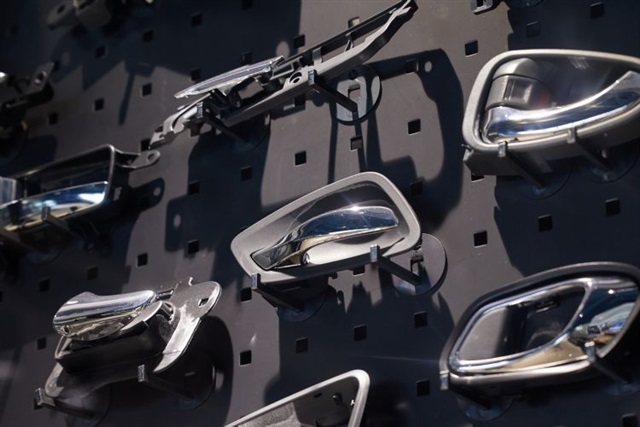
China has stepped up electric vehicle safety regulation, with the Ministry of Industry and Information Technology approving a new mandatory national standard, Technical Requirements for Automobile Door Handle Safety (GB 48001-2026). The rules require all EVs sold in China to feature independently operable mechanical door-opening mechanisms on both the inside and outside, banning designs that rely entirely on electronic systems or concealed handles.
The move positions China as the first country to formally prohibit hidden door handles on electric vehicles, with the regulation set to take effect on January 1, 2027.
The standard requires doors to remain operable through purely mechanical mechanisms in situations such as power outages, collisions, or system failures, ensuring passenger evacuation and external rescue access. Vehicles that have already completed type approval and are close to market launch will be given a transition period, with compliance allowed to extend to 2029.
Flush, retractable, and concealed door handles, first popularized by Tesla, have become a standard design feature among many mid- to high-end EVs in recent years, valued for their futuristic look and aerodynamic advantages. However, multiple accidents in which doors failed to open after power loss — including widely reported cases involving Xiaomi EVs catching fire following collisions — have fueled safety concerns and triggered regulatory intervention.
From a supply chain standpoint, the regulation will affect not only automakers but also coordinated design across door handle modules, mechanical linkage systems, wiring harness configurations, and door structural components. The impact goes beyond isolated design adjustments, particularly for vehicles built around smart functions, low aerodynamic drag, and high-tech styling.
The Cover reported that the policy will affect a broad range of manufacturers, including major Chinese brands such as BYD, Nio, Li Auto, Xiaomi, Geely, SAIC, and Great Wall Motor, as well as international automakers selling EVs in China, including Tesla, BMW, and Mercedes-Benz.
China's tightening EV regulatory framework underscores a clear shift in priorities: in the era of smart electric vehicles, eye-catching design and technological appeal can no longer outweigh safety, which is now firmly positioned as the primary requirement.
Article edited by Jack Wu