

CONNECT WITH US

Foxconn bets on Poland as its European EV beachhead, partnering with state-owned EMP

, DIGITIMES Asia, Taipei
0

Credit: Foxconn

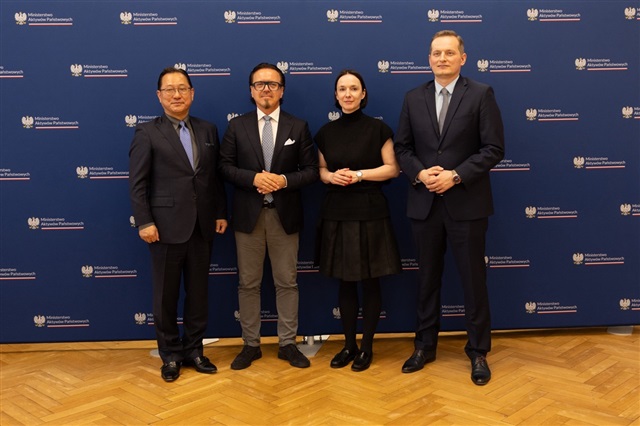
Foxconn announced a strategic partnership with ElectroMobility Poland S.A. (EMP), a Polish state-owned enterprise, to jointly evaluate building an electric vehicle manufacturing and R&D center in Poland. The deal, announced alongside Poland's Minister of State Assets Wojciech Balczun and Deputy Minister Eliza Zeidler, represents the Taiwanese electronics giant's most concrete move yet toward establishing a manufacturing presence on European soil.

The planned facility in Jaworzno — a city in southwestern Poland's Silesia region, near the automotive cluster of Katowice and the manufacturing hub of Wrocław — would cover the full vehicle production stack: body assembly, painting, battery module assembly, electric drivetrain assembly, and final vehicle assembly. Foxconn's EV subsidiary Foxtron Vehicle Technologies is co-leading the initiative. The project will be funded in part through Poland's National Recovery Plan and the Reprivatization Fund.

Why Poland, and why now

The location reflects a deliberate set of structural advantages. At EUR14.5 per hour, Polish manufacturing labor costs are a fraction of Germany's (EUR41.3) and France's (EUR42.2), and modestly lower than neighboring Czech Republic (EUR18) and Slovakia (EUR17.2). Poland's economy reached US$1.04 trillion in GDP in 2025, growing at 3.6% with similar growth projected for 2026, underpinned by a labor force of 18.1 million in a country of 38.4 million, the EU's fifth-largest population.

The more pointed industrial context: automobiles are Poland's second-largest manufacturing sector and fourth-largest export, and Poland is the largest automotive consumer market in the EU's eastern bloc. And yet the country has never produced a domestic passenger vehicle brand, a strategic gap the government has been working to close since EMP's founding in Warsaw in 2016, when it was designated as the state's primary vehicle for building a national EV industry.

The Jaworzno project is the most ambitious expression of that mandate. The planned joint venture is explicitly designed to build a competitive, locally rooted EV brand — not merely an assembly operation for foreign marques — with a phased roadmap toward broader European market entry, while simultaneously strengthening Poland's domestic technical and operational capabilities in EV development.

In their own words

Jun Seki, Foxconn's EV strategy chief, pointed to the company's open-platform approach as the foundation of the deal. "Foxconn has long been committed to accelerating electrified mobility through open platforms, scalable manufacturing, and deep technology collaboration," he said. "We are pleased to work with EMP to share our EV platform, full vehicle development experience, and engineering capabilities to co-build an AI-integrated manufacturing base. Together with Foxtron, we will also deepen local R&D capabilities, strengthen the supply chain system, and serve the European market more efficiently."

EMP CEO Cyprian Gronkiewicz was equally direct about why Foxconn stood out among potential partners. "The founding mission of EMP was to find a partner with both industrial scale and technological depth as a core objective," he said. "Foxconn fully meets these criteria, particularly in manufacturing capability and in developing digital solutions and safety, areas that are indispensable to the future of the automotive industry and will continue to be key to maintaining competitiveness."

Foxconn's contract manufacturing logic

The Poland deal fits within Foxconn's broader "3+3+3" strategy, which positions electric vehicles as one of three core emerging industries alongside digital health and robotics, supported by AI, semiconductors, and next-generation communications. With 2025 consolidated revenues of NT$8.1 trillion and a ranking of 28th on the Fortune Global 500, Foxconn has the financial depth for long-horizon bets — and Europe has been a visible gap in its EV manufacturing footprint.

Foxtron operates on a contract design and manufacturing services model — the automotive equivalent of how Foxconn builds electronics for global brands. The Poland deal extends that model into Europe, where stringent emissions regulations, a push for supply chain localization, and growing scrutiny of Chinese-origin EV components are creating openings for alternative manufacturing architectures. A Foxconn-anchored production cluster inside EU borders, funded by European recovery mechanisms and backed by the Polish state, offers a politically palatable supply chain alternative at a sensitive moment in EU-China trade relations.

The Jaworzno site also benefits from proximity to Poland's two most important industrial clusters. Katowice, the regional hub of Poland's traditional heavy industry and a growing automotive center, lies nearby — and notably formalized a sister-city relationship with Kaohsiung, home to major Foxconn operations in Taiwan, in March of this year. Wrocław, one of Poland's leading advanced manufacturing centers, provides additional supplier and talent depth within close reach of the planned facility.

Article edited by Jack Wu