
On May 6, Elon Musk was in several places at once: confronting OpenAI in court, announcing on X that xAI would no longer operate as an independent company, and handing over a large share of his AI compute to another AI firm, Anthropic. Three years after Musk gathered 12 researchers from DeepMind, Google, and OpenAI to found xAI with the stated goal to "understand the universe," he has now moved to shut it down.
When ChatGPT emerged on the scene, and GPT-4 ignited hopes for artificial general intelligence (AGI), Musk — then a co-founder of OpenAI and its biggest nonprofit backer — could no longer sit still. He publicly warned that AI posed an "existential threat" to humanity and called for a pause in large-model development, while quietly registering xAI to join the unprecedented tech arms race.
Over the next three years, the startup lurched through a frenetic cycle of fundraising, model upgrades, infrastructure buildout, distillation, and mergers. By May 6 of 2026, Musk declared xAI dissolved.
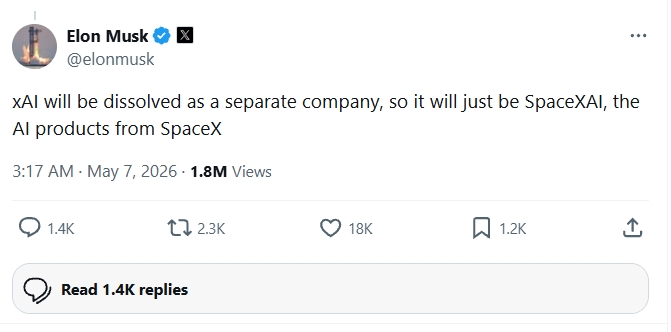
Credit: Elon Musk's X
In fact, xAI had built Colossus, the world's largest AI supercomputing cluster. Starting from a vacant lot in Memphis, Tennessee, it was completed in 122 days and began AI training 19 days after the first rack arrived, a feat Nvidia CEO Jensen Huang praised as something that would normally take 4 years.
But by 2026, all 12 co-founders had left. Musk later admitted on X that xAI was "not built right the first time around."
From AI competitor to compute landlord
The Colossus 1 cluster, made up of 220,000 Nvidia GPUs, will now serve Claude. Earlier in 2026, Musk called Anthropic "evil". By the signing of the deal, he said he had spent a lot of time speaking with Anthropic executives and was deeply impressed.
The builder of the world's biggest supercomputing cluster has essentially become a compute landlord. Musk has shown that a company can build the largest supercluster in 122 days. Assembling an AI team willing to stay is apparently far harder.
Jamin Ball, a partner at investment firm Altimeter, estimated that leasing Colossus 1 compute to Anthropic could bring xAI about US$5 billion in annual revenue, giving Musk at least some way to recoup his investment.
Ironically, on the same day Musk announced the dissolution of xAI, he also appeared in a lawsuit against Sam Altman and other OpenAI leadership. The company's president, Greg Brockman, testified that Musk "knows rockets, he knows electric cars, and I believe he did not — and does not — know AI."
An "evil" company becomes a major customer
Whether or not Musk understands AI, the company that effectively killed xAI was not OpenAI, but Anthropic, a firm he has long denounced. Why has Anthropic's 100-fold growth changed Musk's AI strategy?
In the first quarter of 2026, Anthropic's revenue and usage surged 80-fold, its annualized revenue topped OpenAI's, and its latest valuation reached US$44 billion. Claude Opus 4.6 and Claude Code are now widely viewed as having achieved AGI in the digital domain, with their influence increasingly reflected in both valuation and infrastructure spending.
Anthropic's rapid expansion has had a direct consequence: Musk has abandoned frontier model competition and moved to lease all 220,000 Nvidia GPUs in Colossus 1 to Anthropic.
That will double Claude Code's 5-hour rate limit and give Anthropic, which has been constrained by compute shortages, some breathing room. It also helps close Anthropic's compute gap with OpenAI — a gap that had previously forced it to limit paid-user usage and pushed many users toward Codex.
Notably, Anthropic has committed to spending US$200 billion on Google's AI cloud services and TPU chips, and more than US$100 billion over the next decade on AI capacity from Amazon Web Services (AWS). SpaceX is simply the latest addition to Anthropic's global compute power buying spree.
Musk had planned to enter the AI race with xAI as a contender, but now he also plans to sell compute. Going from his aim to "understand the universe" to selling AI compute to others may not necessarily mean a failed venture, but it is hard to call it the success Musk imagined when he founded xAI in July 2023.
By contrast, Anthropic's annualized revenue surpassed US$30 billion in 2026, and its latest funding round is expected to reach US$40-50 billion, lifting its post-money valuation to US$85-90 billion. The company Musk once insulted has become his biggest customer.
Article translated by Lily Hess and edited by Jack Wu