



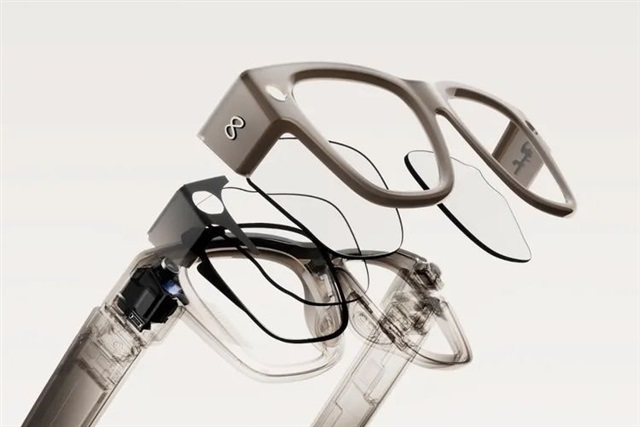
South Korean IC design house Sapien Semiconductor is emerging as a disruptor in the global smart glasses supply chain, after reports that it will supply display backplanes for Meta's next-generation augmented reality (AR) glasses, a development that could loosen China's long-standing grip on key micro-display components.
Citing industry sources, Sedaily reports that Sapien has been selected to supply backplane ICs for Meta's AR glasses scheduled for launch in the second half of 2027, with production talks underway with US-based foundry GlobalFoundries (GF). The device is expected to adopt Micro LED-based LED on Silicon (LEDoS) technology, in which the backplane functions as the display's "brain," controlling millions of microscopic LED pixels.
The decision marks a notable shift for Meta. When it unveiled its Micro LED-based AR glasses prototype Orion in September 2024, several Chinese suppliers, including Jade Bird Display (Shanghai) (JBD), were involved in early-stage development and were widely expected to carry through to mass production. Sapien's selection instead points to a recalibration of supplier strategy, as geopolitical and supply-chain considerations increasingly shape hardware roadmaps.
Meta's AR display strategy has continued to evolve. In September 2025, the company launched its first AR glasses using Micro LCD-driven Liquid Crystal on Silicon (LCoS) displays. It is also evaluating a more affordable Micro LCD-based AR model for 2026, which could adopt displays from South Korean Micro LCD specialist Raontech, currently reported to be in discussions with Meta.
Why Sapien's LEDoS matters
Beyond the supply-chain headlines, the deeper story lies in Sapien Semiconductor's technology edge. The company specializes in display driver ICs (DDICs) for ultra-compact displays, a segment growing more strategic as smart glasses evolve from niche hardware into AI-powered consumer devices.
Sapien's core strength lies in LEDoS, a display architecture widely viewed as well-suited for smart glasses thanks to its high resolution, low latency, and low power consumption within an extremely small form factor. Industry disclosures cited by Thescoop.co.kr show Sapien has achieved a pixel pitch of 2.5 micrometres (µm), currently regarded as the world's smallest, enabling sharper images on displays no larger than a spectacle lens.
Power efficiency is another key differentiator. Sapien's Memory-in-Pixel (MiP) technology embeds memory directly into each pixel, reducing internal data movement. The company says this cuts power consumption by up to 75% and manufacturing costs by about 50% versus competing LEDoS solutions, while faster electron mobility improves response speed and reduces image persistence.
These attributes are gaining relevance as smart glasses move toward "AI in front of the eyes," with generative AI extending beyond smartphones and PCs to wearables capable of real-time translation, navigation, image capture, and contextual assistance.
Meta, big tech, and a fast-growing market
Meta is far from alone in its push into smart glasses. Apple has signalled plans to launch AI-powered smart glasses around 2026–2027, building on its Vision Pro XR headset introduced in 2024. Google has partnered with Samsung and eyewear brand Gentle Monster to co-develop AI glasses powered by its Gemini platform, according to KED Global, while China's Alibaba entered the market in October with its Quark smart glasses.
This momentum is reflected in market forecasts. Grand View Research estimates the global smart glasses market will grow from US$1.9 billion in 2024 to US$8.2 billion by 2030, underscoring why display semiconductors are becoming a strategic chokepoint.
Against this backdrop, Sapien has reportedly signed non-disclosure agreements with more than 70 smart-glasses-related companies worldwide, positioning itself as more than a component supplier and increasingly as a core technology partner. Analysts cited by Thescoop.co.kr say order momentum has exceeded expectations, with 2025 revenue forecast at KRW19.5 billion (approx. US$13.3 million), more than double year-over-year growth.
Profitability remains a work in progress. Sapien's operating loss narrowed from KRW6.9 billion in 2023 to KRW3.4 billion in 2024, a trend viewed as encouraging but still reflective of heavy upfront R&D investment in advanced display semiconductors.
Geopolitics meets micro displays
Industry observers note that China continues to dominate much of the smart-glasses component ecosystem, particularly in micro-display manufacturing. Sapien's move into backplane ICs — among the most critical and defensible layers of the display stack — nonetheless signals a meaningful shift.
AR devices are increasingly used beyond consumer electronics, including in defence and security, adding a national-security dimension to sourcing decisions. As the US government steps up efforts to reduce reliance on China-linked supply chains, South Korean component makers appear well-positioned to benefit.
In that sense, Sapien's chips, smaller than a screw in a pair of glasses, carry more than pixels. They sit at the intersection of AI wearables, semiconductor geopolitics, and emerging human–machine interfaces, positioning Sapien as a bellwether for how the smart glasses supply chain may evolve through 2027 and beyond.
Article edited by Jack Wu
