
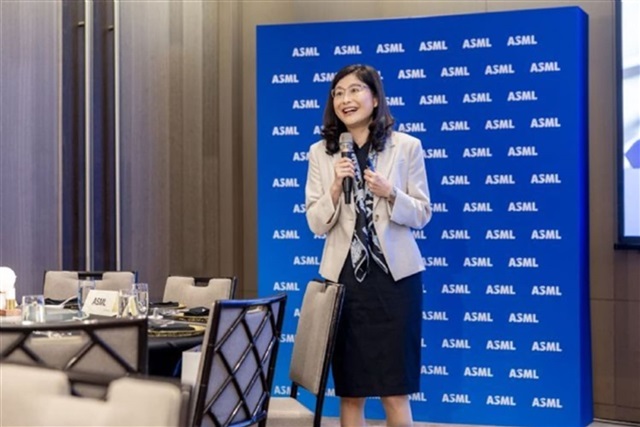
Grace Wang, vice president and general manager of ASML in Taiwan, said that ASML plans to deploy extreme ultraviolet (EUV) and next-generation high numerical aperture (high-NA) EUV technologies to reduce energy consumption per wafer at the process level, while continuing to deepen its presence in Taiwan. The company also plans to hire around 1,000 new employees in Taiwan in 2026 to support customer expansion and rising global capacity demand.
With rapidly surging demand for artificial intelligence (AI), high-performance computing (HPC), and data centers, Wang noted that the AI era is driving unprecedented demand for computing power, while also intensifying energy consumption and carbon emission pressures across the semiconductor industry.
Chips, power, and a looming carbon crunch
Wang noted that semiconductors are a key foundation for digitalization and AI development, but the power demands of AI data centers are expanding rapidly. Building large AI data centers now often requires several gigawatts (GW) of electricity, and the energy consumed by a single AI training model can be equivalent to the output of several nuclear power plants or the entire North Sea offshore wind fleet.
If process efficiency is not improved through technological innovation, total carbon emissions from the semiconductor industry could see a significant increase before 2030 as demand for AI chips continues to grow.
Wang added that ASML's current core strategy is to reduce energy consumption per wafer by simultaneously increasing the production capacity of its lithography equipment and simplifying process steps.
ASML's latest flagship EUV lithography system, the TWINSCAN NXE:3800E, illustrates this ambition: its wafer-per-hour output has already increased from 220 to 230 wafers. The company plans to raise this to 400 wafers per hour by 2031 and expects overall EUV equipment output capacity to increase by 50% before 2030.
As machine output increases, more chips can be produced with the same energy input, which naturally reduces the energy consumed per wafer.
High-NA EUV: fewer steps, sharper results
ASML is also actively advancing high-NA EUV technology. Wang noted that in past deep ultraviolet (DUV) and early EUV processes, wafer fabs relied on multi-patterning techniques to achieve the precision required for advanced nodes. However, multi-patterning significantly increased process steps, power consumption, and costs.
High-NA EUV can consolidate processes that previously required multiple exposures into a single exposure, replacing up to four repeated exposure steps. This helps improve yield, shorten production cycles, and simultaneously reduce wafer manufacturing costs and energy consumption.
Efficiency gains since mass production
Wang stated that since EUV equipment entered mass production in 2018, ASML has reduced energy consumption per wafer exposure by 57%, and expects a further reduction of 30% or more over the next five to ten years. While EUV is often referred to as a "power-hungry" technology, ASML is working to help customers reduce overall fab power consumption by improving machine efficiency and optimizing processes.
Beyond equipment-level energy efficiency gains, ASML is also working with customers on hydrogen recovery and reuse, cooling water optimization, and a machine "sleep mode" for dynamic energy saving. These measures shift equipment away from long standby periods toward on-demand operation, improving overall power efficiency.
ESG milestones and circular ambitions
In terms of environmental, social, and governance (ESG) efforts, as of the end of 2025, ASML's global manufacturing facilities and office buildings have officially achieved greenhouse gas neutrality and reached 100% renewable energy usage. Between 2021 and 2025, the company accumulated 148 terajoules (TJ) in energy savings. In 2025, 26 systems were delivered to customers by sea to reduce logistics-related carbon emissions.
Wang said that since 2019, ASML Taiwan has completed more than 130 system refurbishments and repaired and reused nearly 10,000 components, extending equipment life cycles and reducing resource waste.
Taiwan: ASML's indispensable outpost
In its global operations, Taiwan remains one of ASML's most important strategic hubs.
Wang noted that ASML currently operates eight factories worldwide, including facilities in Linkou and Tainan in Taiwan. The company employs 4,700 people on the island, accounting for about 10% of its global workforce. In 2025, the Taiwan market contributed EUR8.3 billion (approx. US$9.67 billion) in revenue to ASML, representing 25.5% of its global revenue and highlighting Taiwan's critical role in the global advanced semiconductor manufacturing supply chain.
To support AI-driven demand for advanced process capacity expansion, ASML plans to increase hiring in Taiwan by around 1,000 new employees in 2026, up from the originally planned 600. Hiring will focus on customer support, installation engineers, smart manufacturing, production, and supply chain management to meet rising global equipment capacity and customer expansion needs.
Article translated by Eifeh Strom and edited by Jerry Chen