
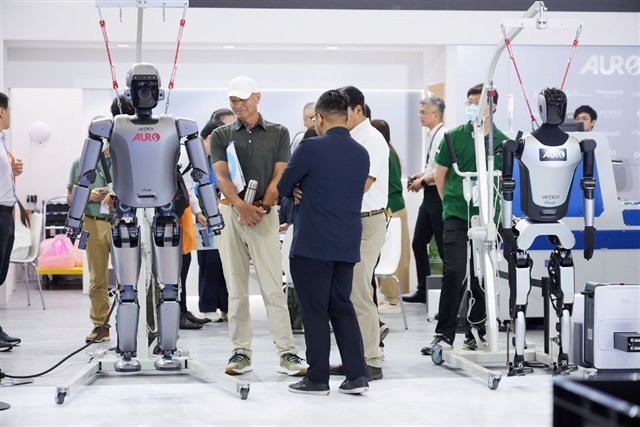
China's AgiBot Innovation (Shanghai) Technology has shipped its 10,000th humanoid robot, the Agibot Expedition A3, signalling early mass production at scale. Output doubled from 5,000 units at the end of 2025 within three months. While Tesla's Optimus timeline remains under scrutiny, China's humanoid robot push is already scaling, led by AgiBot, Unitree Robotics, and Ubtech Robotics in an emerging three-player structure.
Research firm data varies slightly but converges on one signal: 2025 is the inflection point for humanoid robot commercialization. AgiBot and Unitree each shipped about 5,000 units, together accounting for over 70% of global volume.
Ubtech follows with roughly 1,000 units shipped. China's humanoid robot market is consolidating into a three-player structure, with each company pursuing a distinct scaling strategy.
Unitree — Low-cost strategy opens entry market
Unitree reset pricing in July 2025 with its R1 humanoid robot at US$5,900, compressing cost expectations and pushing humanoid robots closer to consumer electronics price bands.
The strategy mirrors Xiaomi's playbook: aggressive entry pricing to unlock volume. It has opened demand in price-sensitive segments, particularly education and research.
Official data shows 73.6% of Unitree's humanoid robot revenue in the first three quarters of 2025 came from research and education, 17.39% from commercial consumption, and 9% from industrial use. Customers are primarily universities and research institutions, with deployments focused on development rather than production lines.
AgiBot — '30-minute' supply chain moat
AgiBot takes the opposite path, targeting industrial deployment with entry prices starting from US$14,500. Key use cases include automotive manufacturing, precision assembly, and hazardous operations.
AgiBot's moat centres on supply chain integration. Founder Peng Zhihui has identified a tightly coordinated supply system as critical to scaling production.
With no mature suppliers initially available, AgiBot brought partners into joint development and dedicated supply arrangements. This secured control over core components and created a "30-minute" supply chain, requiring key suppliers to respond within half an hour.
The model raises short-term execution pressure but builds long-term defensibility. Joint development is improving key components such as joints and dexterous hands, reducing weight, extending lifespan, and lowering cost.
Ubtech — Full-stack ecosystem across use cases
Ubtech, China's first publicly listed humanoid robot company, is focused on scenario-driven deployment and ecosystem build-out across industrial manufacturing, commercial services, and home use.
Its Walker S series is deployed in factory training at Audi FAW NEV Co. and BYD, giving it the widest footprint in industrial training environments globally.
Founder James Zhou emphasises a full-stack hardware-software model rather than single-component breakthroughs. Ubtech is building across components, algorithms, and systems, using ecosystem deployment to accelerate iteration.
Deployments span automotive assembly at NIO's second advanced manufacturing base, guided services in smart showrooms, and warehouse logistics. These scenarios scale deliveries while feeding real-world data, including gait and task scheduling, back into system optimisation.
Unitree is driving entry-level adoption at US$5,900, AgiBot is building industrial barriers through supply chain integration, and Ubtech is scaling through a multi-scenario ecosystem—three distinct paths converging on humanoid robot commercialisation.
Article translated by Levi Li and edited by Jack Wu