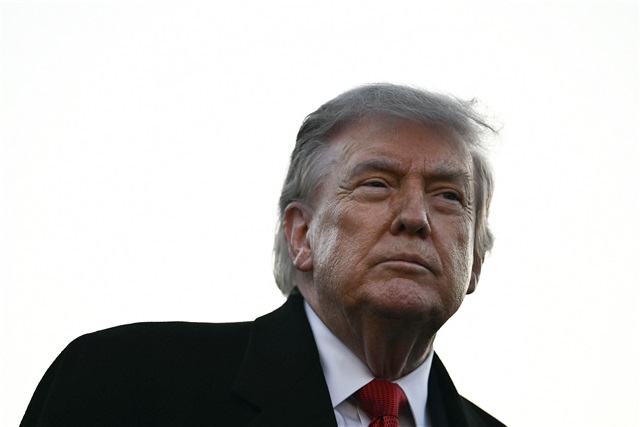
CEOs from Nvidia and other American tech companies are among those that the US government plans to invite to join President Donald Trump's visit to China next week. Along with the trade negotiations, the US leader has also sought to frame the summit as a type of high-level trade delegation, although the White House is reportedly considering inviting only a small number of executives.
Semafor reported that leaders from Apple, Nvidia, and Qualcomm are on the list of possible invitees to the China trip. The list also includes CEOs from other industries, such as the leaders of Blackstone, Exxon, Boeing, Visa, and Citigroup. More companies are expected to join the lineup as the date of the visit nears.
Members of Trump's government have brought up suggestions as to who should be invited for the trip, according to the publication, and the US president has reportedly been seeking to stoke "fear of missing out" among executives about the visit.
However, the White House and Treasury may possibly invite only around a dozen company heads, in order to keep the meeting focused on trade issues. A full list of the companies invited has not been confirmed.
An elusive market for Nvidia
Nvidia CEO Jensen Huang has said that he would be glad to join Trump on the China trip if he were invited, which indicates that he still has yet to receive an invitation, according to Bloomberg. It would be notable if Huang were not invited, given that AI and semiconductor restrictions may be core topics under discussion.
Huang has had to navigate the tricky relationship between China and the US regarding Nvidia's advanced GPUs. The US had placed restrictions on shipments of its H200 AI chips to China after deciding to allow them in January.
Since then, Nvidia's share in the China data center market has plunged to zero, as the Chinese government has taken the US export restrictions as an opportunity to develop domestic alternatives to Nvidia and has, in turn, restricted imports of the H200 chips. Huang has since argued that cutting off US chips to China has backfired, instead strengthening Chinese competitors rather than weakening them.
Other executives, such as CEOs Steve Schwarzman of Blackstone and Jane Fraser of Citigroup, already intend to attend the summit. It remains to be seen whether Apple CEO Tim Cook would attend if invited, as the company remains highly reliant on the Chinese market and supply chains, and he may worry about being seen by the Chinese leadership as taking sides.
What is up for discussion?
The trip by the American leader to China, the first in nearly a decade, is scheduled to take place on May 14 and 15. Reuters reported that many analysts and business leaders are not expecting significant changes from the meeting, except possibly an extension of a truce to end the trade war between the two sides, signed in October last year.
Those discussions, which were held between Trump and Xi in South Korea, led to the US side shaving off 10% from tariffs on Chinese imports to 47% and agreeing to delay for a year an effort to bar Chinese companies that are partly owned by a sanctioned firm from receiving US technology. The Chinese side, on the other hand, promised to crack down on illegal fentanyl flows to the US, resume paused exports of rare earth minerals for a year, and buy 25 million tons of soybeans for the next three years.
Yet back in October, some important topics were not discussed. Trump did not mention sales of Nvidia Blackwell chips back then. This time, AI and chips may play a more important role in the talks, especially if Huang joins the US president in China.
It has been reported that Beijing and Washington have begun discussing the formation of a formal AI security dialogue mechanism due to mutual concerns about the military and cybersecurity risks of an out-of-control AI arms race. However, the aims of both sides may not be completely aligned, as the US likely hopes to pursue a basic level of risk management, while China may be seeking eased controls on exports and technology.
Both sides want the other to ease restrictions to benefit their tech sectors. Reuters reported that the US wants China to allow exports of critical minerals and rare earths, which have disrupted American manufacturers. China, in turn, wants Washington to ease restrictions on advanced chip exports, and Beijing has raised concerns about a possible law preventing shipments to China of chipmaking equipment.
Taiwan was also not mentioned during the previous talks in October, according to Trump. This time may be different. Analysts have noted that China remains concerned about the Taiwan issue and that Xi may demand that the Trump administration reduce its political and military support for Taiwan. As for Trump, some posit that he sees Taiwan as more of a bargaining chip than his predecessors.
Other trade matters under discussion between Beijing and Washington may include the creation of a mechanism to find trade products that can promote trade without harming critical supply chains or national security, according to Reuters. Possible discussions could also include Chinese purchases of US agricultural products and Boeing aircraft, as well as the ongoing Iran war.
Article edited by Jack Wu