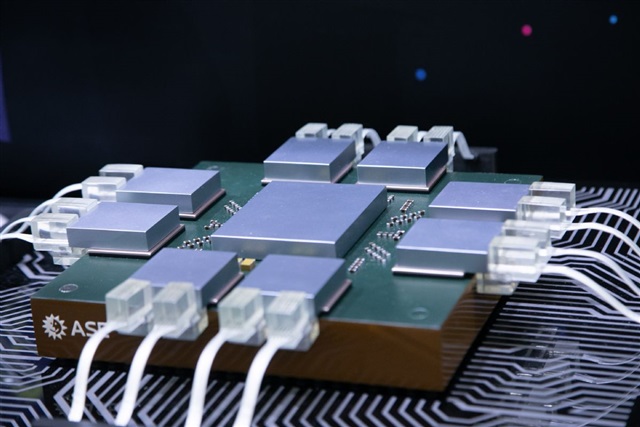
A new trend is emerging in the AI infrastructure race. After MediaTek invested in US silicon photonics start-up Ayar Labs, Nvidia followed with US$2 billion investments in optical communications suppliers Lumentum and Coherent, signalling stronger momentum behind optical interconnect technologies for AI data centers.
The investments are already strengthening sentiment across Taiwan's optical communications supply chain, including III–V compound semiconductor foundries and epitaxial wafer suppliers.
Nvidia said the funding will support research and development, capacity expansion, and US-based manufacturing. The agreements also include long-term procurement commitments worth tens of billions of dollars and priority access to production capacity for advanced lasers and optical networking components.
For the broader industry, the signal is clear. Optical interconnects are moving from experimental deployments toward core infrastructure for large-scale AI data centers.
CPO momentum builds across AI supply chains
Industry insiders say Nvidia's investments in optical communications companies and long-term supply agreements are not surprising. The company has been among the most aggressive promoters of co-packaged optics (CPO) deployment, pushing suppliers to accelerate development and manufacturing readiness.
The strategy has clear motivations. Optical interconnect advances could strengthen Nvidia's system-level AI platforms for hyperscale customers. At the same time, competition with Broadcom in high-speed networking makes early positioning in CPO strategically important.
However, the urgency now extends beyond Nvidia and the AI chip supply chain.
Earlier momentum around optical communications largely reflected positioning among technology vendors. Today, the main driver is demand from cloud service providers and AI customers seeking higher efficiency and scalability in AI computing infrastructure.
Though copper and optical technologies are expected to coexist, optical interconnect adoption still has significant room to expand in manufacturing scale, technical maturity, and cost efficiency.
Copper interconnects approach scaling limits
Executives in the AI chip ecosystem say cloud operators have historically pushed copper interconnects to their limits, largely because of cost considerations and concerns about the reliability of newer optical technologies.
In practice, data center operators used copper wherever performance allowed, shifting to optical solutions only when bandwidth requirements exceeded copper's capabilities.
That dynamic is now changing. Interest in CPO technology is shifting from observation to deployment planning. Chipmakers specialising in high-speed interconnect technologies say the number of cloud customers remaining on the sidelines is rapidly declining.
Many are now evaluating large-scale CPO deployment, with optical communications components expected to see higher adoption within the next one to two product generations.
Interconnect bottlenecks reshape AI data centers
Industry sources in the IC design sector say the focus of AI data center upgrades is shifting. While computing power once dominated discussions, attention is increasingly turning to bottlenecks such as interconnect bandwidth, power consumption, and thermal management.
Even within an interconnect architecture, the challenge extends beyond introducing CPO at scale. The key objective is balancing optical and copper technologies while optimising transmission efficiency, heat management, and power consumption.
Achieving this balance will require close coordination across the ecosystem, including chip designers, optical component suppliers, and cloud infrastructure providers.
For Nvidia, MediaTek, and Broadcom, the key challenge in the coming years will be how quickly they can deliver practical CPO solutions at scale.
Beyond technical progress, supply risks may also emerge. The recent shortage in memory components has already raised concerns across the industry. A similar surge in demand for optical communications hardware could create new supply constraints.
Nvidia's demand for priority supply rights in its latest agreements reflects how seriously the company views that potential risk.
Article translated by Levi Li and edited by Jack Wu