

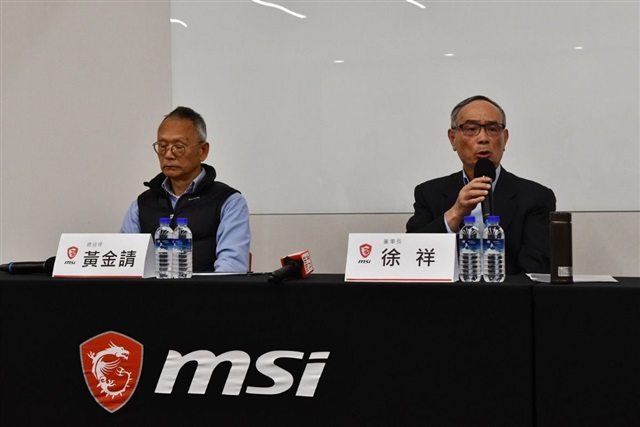
With artificial intelligence (AI) demand surging and key components such as memory in tight supply, Micro-Star International (MSI) chairman Joseph Hsu and president Jeans Huang said the company is actively expanding in the AI server market, achieving growth of 50 to 100% in 2025, and expects to maintain strong growth in 2026. In addition, they expect gaming products to see a price increase of about 15 to 30% in 2026 due to the impact of rising memory costs.
PC shipments to fall in 2026
Hsu explained that the traditional "seasonal cycle" long relied upon by the PC industry is gradually disappearing. In the future, shipment rhythms will no longer be driven by market demand but by GPU supply.
According to Hsu, the rapid rise in AI computing demand has led AI servers to take priority for GPU and high-end memory capacity. In the past, the PC market experienced clear peak seasons around national holiday promotions, back-to-school periods, and year-end holidays. However, with chip supply constraints, the market's seasonal rhythm is undergoing a structural change.
Hsu emphasized that under tight GPU and high-end memory supply, future PC industry competition will no longer focus solely on sales volume. Instead, it will test manufacturers on product mix, supply chain management, and high-end market positioning.
Huang added that the PC market faces multiple pressures in 2026. In addition to overall demand being affected by macroeconomic factors, the crowding-out effect of AI investment continues to grow. Combined with the lack of major new product launches, market momentum has clearly weakened. Based on various estimates, global PC shipments in 2026 could decline by more than 10%, with a potential drop of up to 20%.
Adjusting PC pricing strategies
On the supply chain side, soaring memory prices have forced PC brands to readjust their pricing strategies. Since the fourth quarter of 2025, DDR5 prices have risen sharply, with some specifications increasing two- to threefold, putting significant pressure on the cost of motherboards and complete systems. To reflect rising costs, MSI has gradually adjusted its end-product prices.
Although market demand remains uncertain, shrinking supply has eased price competition. In other words, the current environment is no longer about cutting prices to gain market share; instead, those who can secure components hold the leverage to negotiate prices.
MSI expects 2026 operations to follow a lower volume, higher price pattern. Even if PC shipment volumes fall, revenue performance and profitability can improve through price adjustments and product mix optimization.
In terms of product strategy, mid- and low-tier products have historically accounted for more than 30% of MSI's portfolio. With key component supplies limited, the company plans to prioritize high-priced product lines such as gaming and commercial, as well as concentrate research and development resources on high-value-added products.
AI servers to drive growth
MSI's gross margin returned to a healthy level in the first quarter of 2026, with further improvement anticipated after cost-reflective price adjustments take hold after the second quarter. Beyond its core PC business, AI servers have become the company's most important growth driver.
Hsu noted that since 2024, MSI has been actively investing in the development of AI computing products. Although AI servers currently only account for a single-digit percentage of total revenue, the company has set a target of at least 50% annual growth in AI server revenue over the next three years.
Unlike large cloud service providers, MSI focuses on small and medium-sized businesses and the enterprise-level AI application market, offering flexible, cost-effective computing platforms. As AI applications become more widespread, enterprise demand for AI servers will continue to grow. While gross margins for AI servers are currently lower than for PC products, their vast market scale makes them an important source of a second growth curve.
Expanding production to mitigate risks
To mitigate geopolitical and tariff risks, MSI has accelerated adjustments to its global capacity layout in recent years. Its main manufacturing bases remain concentrated in China, with the Kunshan facility handling notebook and automotive product assembly, while the Baoan facility focuses on graphics cards and other non-notebook products.
In terms of overseas expansion, MSI's new US facility officially began operations in early 2026, primarily handling data center and AI server assembly. Going forward, depending on customer demand, the company plans to shift over half of its server production capacity to the US to meet local data center needs and government procurement requirements for "Made in USA" products.
In Europe, MSI's facility in the Netherlands is currently undergoing renovation, with completion scheduled for late 2027, at which point a full European production line will be established. Meanwhile, a new plant in Taoyuan, Taiwan, is under accelerated construction and is expected to be completed by the end of 2026. This facility will support new products such as AI servers, industrial computers, and charging stations. As global production capacity gradually comes online, MSI will have greater supply chain flexibility over the next three to five years to respond to changes in tariff policies and market demand.
MSI posted consolidated revenue of NT$230.20 billion (approx. US$7.18 billion) in 2025, up about 16% year-over-year and a record high. However, net profit after tax fell over 15% to NT$5.75 billion, impacted by currency fluctuations in the second quarter, tariff policies, and rising component costs. Earnings per share dropped to roughly NT$6.80 from NT$8.04 in 2024, while gross margin declined 1.2pp to 11%.
Article translated by Eifeh Strom and edited by Jack Wu