

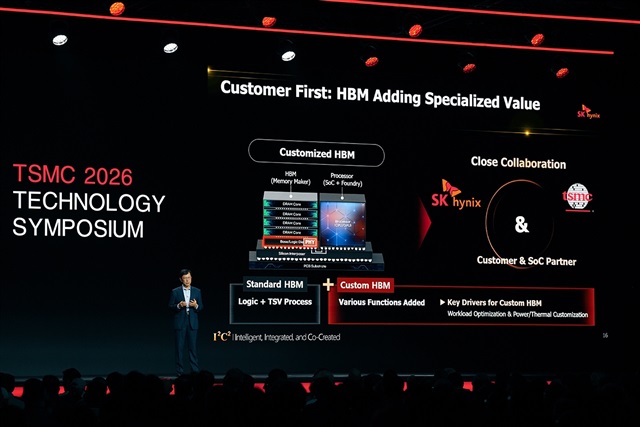
SK Hynix showcased its latest high-bandwidth memory (HBM) technologies at TSMC's North America Technology Symposium 2026, highlighting closer collaboration with the foundry and outlining a strategy focused on integrating memory and logic.
The company displayed its fifth-generation HBM3E, next-generation HBM4, and server DRAM products at the event, according to Korean media reports, including Yonhap News Agency and iNews24.
HBM4 highlights growing collaboration with TSMC
At the exhibition, SK Hynix indicated that its HBM4 adopts a base die built using TSMC's logic process, reflecting closer technical cooperation between the two companies.
The product combines a fifth-generation 10nm-class DRAM process with a 12nm base die from TSMC, according to the reports. Product descriptions at the booth also referenced the use of TSMC's logic technology in the base die.
Ahn Hyun, chief development officer at SK Hynix, said in a keynote address that integrating memory and logic technologies will be key to improving system performance.
"The biggest constraint in advancing AI is the memory bottleneck that cannot keep pace with data processing speeds," Ahn said, according to Yonhap. "A new approach beyond incremental architectural improvements is required."
He added that the company is expanding its role beyond a component supplier to participate earlier in system architecture design, moving toward customized memory solutions.
Roadmap expands to customized memory solutions
SK Hynix said it plans to strengthen collaboration with TSMC by applying advanced logic processes to the base die starting with HBM4.
The company also outlined plans to expand beyond standard HBM to customized memory offerings tailored to specific workloads, including high-bandwidth flash (HBF) and 3D-stacked DRAM on logic.
SK Hynix said the symposium provided an opportunity to reaffirm its partnership with TSMC and communicate its technology direction.

A 3D model showcasing the 16-layer 48GB HBM4 product and its enlarged internal structure. Credit: SK Hynix
Article edited by Jack Wu