

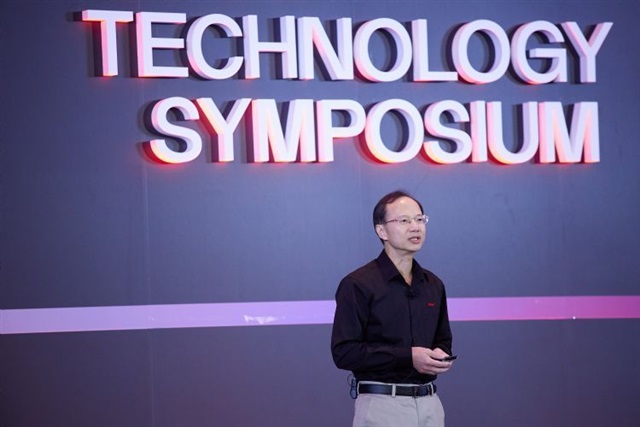
TSMC held its annual technology symposium in Hsinchu on May 14, 2026, after its North America stop, with executives noting that AI applications are rapidly expanding from cloud data centers to edge devices — driving surging demand for semiconductor compute density, high-bandwidth connectivity, power efficiency, and thermal management. Ray Wan, director of Asia-Pacific business, said TSMC will leverage advanced process technology and advanced packaging to help customers accelerate innovation in the AI era.
Where AI is heading
Wan said AI is continuing to expand and permeate daily life, injecting new momentum into global technology and industrial progress. According to Wan, cloud and data center operators are running larger AI models and performing more complex, faster simulation and computing tasks, while generative AI and AI agent workflows are also spreading quickly, driving exponential growth in compute demand.
Those simulation workloads and AI agent applications are expected to help speed drug development, scientific research, and manufacturing efficiency, and further improve everyday productivity. But they are also pushing the limits of the AI infrastructure supply chain, with demand rising across extreme compute density, high-bandwidth data transmission, and efficient power delivery and cooling.
AI at the edge
Wan said AI is also moving deeper into edge computing, including in appliances, PCs, cars, and smartphones. These devices will increasingly deliver real-time environmental sensing and intelligent responses, with smartphones already evolving into personal AI assistants.
In the edge AI era, low latency, low power consumption, and high reliability will be key requirements, he said, and those needs must rest on a semiconductor supply base that is solid, trustworthy, and capable of large-scale mass production.
Wan said TSMC can provide industry-leading support for AI chips, from semiconductor manufacturing to advanced packaging solutions.
Asia-Pacific momentum in 2025
Looking back at TSMC's 2025 results in the Asia-Pacific region, customers used more than 2.1 million 12-inch wafer equivalents throughout the year. Stacked vertically, those wafers would reach about 1,600m in height.
Those wafers helped customers ramp about 2,600 products into mass production, spanning smartphones, power management, solid-state drives, TVs, networking, USB, mobile video, and automotive applications.
Customers also launched about 400 new products in 2025, averaging more than one product entering mass production every day. Wan said the results underscore customers' capacity for innovation and differentiation, as well as TSMC's ability to work closely with them to bring products smoothly into mass production.
Article translated by Charlene Chen and edited by Jerry Chen